An Impossible Construction

I enjoy offering impossible problems to students as extra credit, although I usually don’t tell them the problems are impossible.  Such tasks usually engage them, confuse them, and make them suspicious of me.  It’s a win-win-win.

While discussing some three-dimensional geometry, I offered extra credit to anyone who could build a model of a Klein bottle.  The Klein bottle is a hard-to-imagine surface that has neither an inside nor an outside.  It’s like a tube where one end meets the other and makes a seal, but somehow got turned inside out in the process.  If you are familiar with the Mobius strip, the Klein bottle is basically a higher-dimensional Mobius strip.

One reason that the Klein bottle is hard to visualize is that it can’t be observed in three dimensions:  it needs a fourth dimension in order to see it turn itself inside-out.  This is analogous to the standard construction of the Mobius strip:  we take a long strip of paper, give one end a half-twist, and tape the ends together.  We think of the paper itself as being 2-dimensional, but we need that third dimension to twist through.

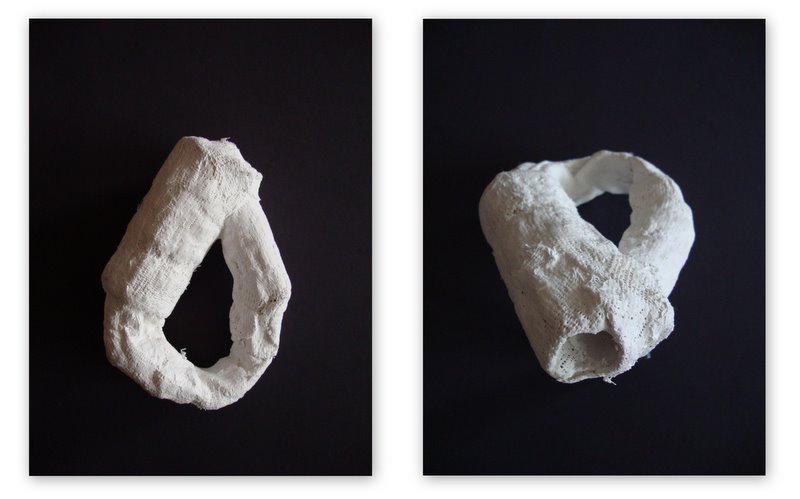
So, I was pretty impressed with the student who made this.

Klein Bottle
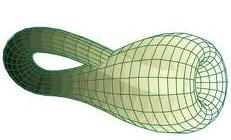
Not bad at all, for someone who is dimensionally challenged.  Here’s a nice representation for comparison, although it’s still a cheat.  The Klein bottle doesn’t really intersect itself.

Klein bottle graph

A nice example of impossibly creative student work!

Plotting the Sun’s Path

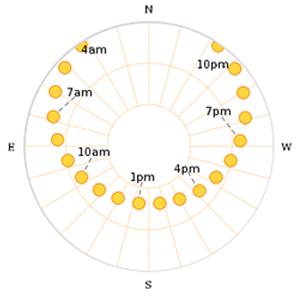
sun pathHere’s a cool article from the Wolfram Alpha Blog about using WolframAlpha to plot the sun’s path, as seen from various locations:

http://blog.wolframalpha.com/2010/09/22/following-the-suns-unique-path/

You can also alter the date, which means you can look at historical data or projected future data.

Unfortunately, when I tried the command “sunpath north pole” (employing the classic mathematical strategy consider extreme cases), WolframAlpha gave me the sun path for North Pole, Alaska, a very oddly named place as it is nowhere near the actual North Pole.

Some Strange Circles

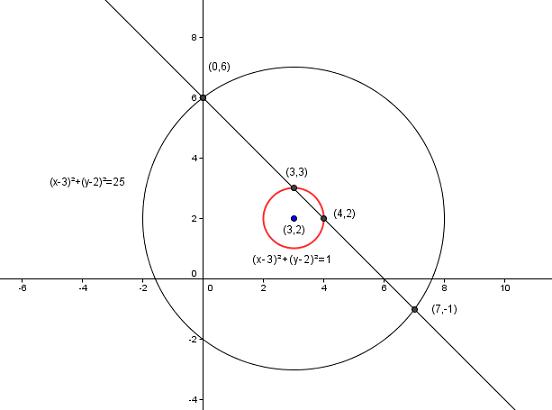
I was trying to construct a simple, introductory intersection problem for the first day of Calculus class, so I started with a well-behaved circle:

This is a circle centered at (3,2) with radius 5.  I picked two points on the circle, (0,6) and (7,-1), found the equation of the line between them, and put together my system of equations:

So I had successfully reverse-engineered my circle-and-line intersection problem with two nice solutions:  (0,6) and (7,-1).

Unfortunately, I made a typo on the handout.  At the end of the left side of the circle equation I wrote ” + 12″ instead of ” – 12″.

So all my work was for naught.  Or so I thought.  Turns out, at least two amazing things happen:

First, the new circle still ends up having a nice radius, namely 1.  What’s even more amazing is that the new circle also ends up having two nice intersections with the given line, (3,3) and (4,2)!

Strange Circles

I wish my intentional work always turned out as well as this mistake!

Tighter Airline Seats

new airline seatThere is an interesting article in the Times about a new kind of airline seat.  Amusingly called the SkyRider, it’s more squat than seat.  I think the look on this guy’s face says it all.

Not surprisingly, this is all about money–and a lot of it.  This seat has a pitch of 23 inches; pitch is airline jargon for the distance between a point on a seat and the identical point on the next seat, sort of like the wavelength of a wave.  On typical commercial aircraft, pitch is closer to 32 inches.  An airline could therefore install many more of these new seats, and of course, more seats means more tickets means more money.

For instance, on an aircraft with 20 rows of seats with a 32-inch pitc you could get almost 28 rows of SkyRiders in there.  That’s 8 extra rows, so about 48 extra tickets.  At two or three hundred dollaras per ticket, that’s a nice increase in revenue–on the order of an extra $10000 per flight.  You could even charge less for these seats and still make more money.

As bad as this sounds, it’s not nearly as objectionable as paying to use the bathroom on a plane.

Bagel-nomics

bagelI have a natural tendency toward the quantitative side of things.  That, together with a substantial history of employment in the food service industry, has doomed me to forever over-analyze menu prices.

I recently realized that my local bagel shop has been charging me an outrageous premium for premium cream cheese.  The cost of a bagel is 95 cents, and a bagel with cream cheese is $1.90; these are pretty standard prices around town.

But here’s the kicker:  a bagel with scallion cream cheese at this place is $3.25.  That’s an additional $1.35–not for the cream cheese, mind you, but for the upgrade of scallion cream cheese over plain cream cheese.

Scallions.  Scallions are like onion weeds.  I buy a bundle of ten of them for 40 cents, use three of them, and then toss the rest, probably because they’ve wilted within two days of purchase.  They are expendable stalks at the bottom of the vegetable pyramid–savory and crisp, yes, but almost literally a dime-a-dozen.  If anything, scallion cream cheese should be cheaper than plain cream cheese, because whatever volume of cream cheese is being replaced by the scallions is almost certainly more valuable than the scallions themselves.

The guys behind the counter seemed sympathetic to my argument, but they still charged me $3.25.

Follow

Get every new post delivered to your Inbox

Join other followers: