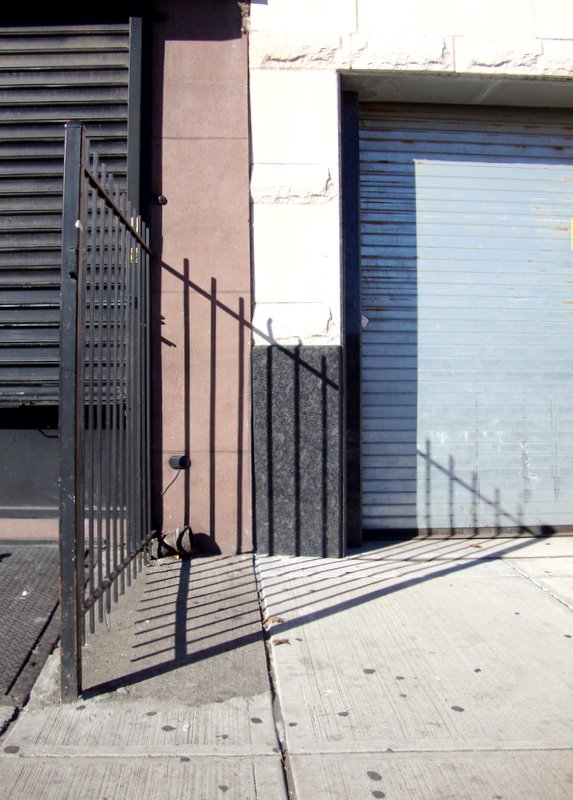
The sun sometimes turns rectangles into triangles. A nice Sunday morning image.
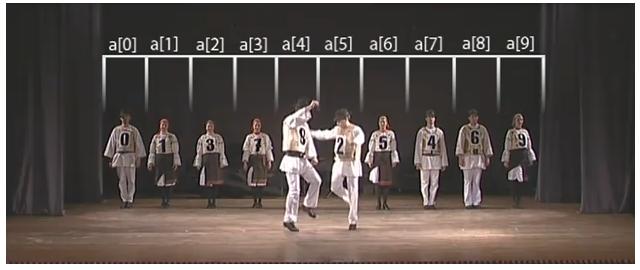
This is a fun and whimsical demonstration of bubble sorting through dance!
http://www.youtube.com/watch?v=lyZQPjUT5B4
The dancers arrange themselves in numerical order in the same manner one would bubble sort an unordered list. One by one, each number “compares” himself with the number on his left; if they are out of order, they switch places. Make you’re way down the list, and start again at the front. Repeat until no one switches places and voila! everyone’s in order!
And just to be thorough, the troupe does dance-representations of Insert-Sort, Shell-Sort, and Select-Sort algorithms as well!
My contribution to Pi Day Celebrations: a student-made necklace that encodes the first 80 or so digits of pi in beads!
Starting with the pendant as 3, the student carefully strung the beads in a circle (clockwise) according to the following mapping:
Thus, you can read off 3.14159265358, and so on. A truly thoughtful, creative, and inspired work! I think the student’s original inspiration might have been this other pi-themed necklace.
Related Posts
This is an innovative and intriguing idea: a graphic novel based on the infamous struggles to articulate the foundations of mathematics.
The story is apparently narrated by the great mathematician and philosopher Bertrand Russell, and the cast of characters includes Georg Cantor, Kurt Godel, Ludwig Wittgenstein, and many other prominent figures from mathematics and logic. A review in the New York Times can be found here.
The philosophy of mathematics is extremely interesting (start by asking yourself “What is a number?”), and this particular tale is truly a fascinating one. I am eager to see how these graphic artists tell the story.
This is a cool article about how important the ellipse is to the artist.
http://opinionator.blogs.nytimes.com/2010/09/23/the-frisbee-of-art/
The author gives a nice, if long, explanation about the significance of the ellipse, but it basically boils down to this: circles are everywhere. And often, when we are looking at circles, we’re looking at them atilt. We see projections of the circle, and projections of circles are ellipses.
Think of it this way: suppose you have a hula hoop and you hold it parallel to the ground. The shadow you see is circular, but if you tilt the hula hoop, the shadow will change–into an ellipse. I don’t have a hula hoop, so I made do with a spare key ring:
As the circular key ring is rotated, it becomes less parallel to the ground; the shadow becomes less circular and more elliptical. And at the end, the ellipse vanishes–an ellipse eclipse!