Here are the most popular Math Photos from MrHonner.com for 2012. Click here to see more.
 |
 |
 |
| Isosceles Triangle in Nature | Beautiful Diagrams | Riemann Building |
 |
 |
 |
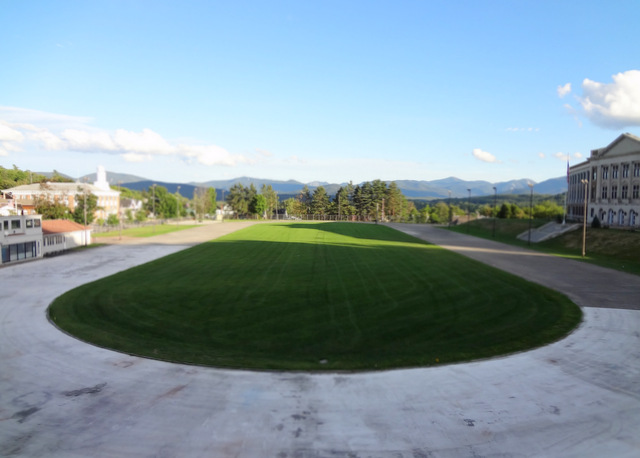
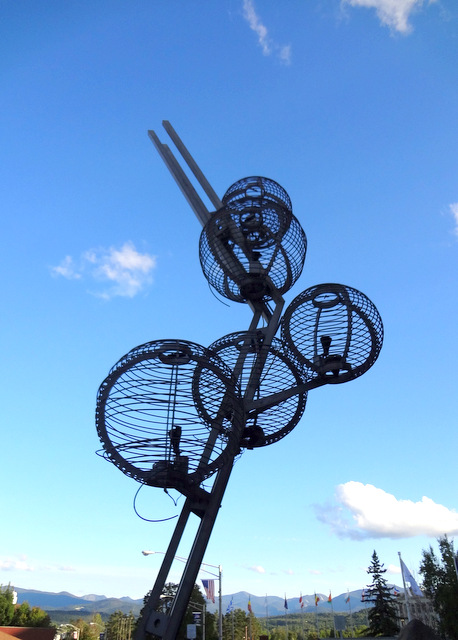
| 400 Meter Oval | Sculpture of Spheres | Anamorphic Art |
Here are the most popular Math Photos from MrHonner.com for 2012. Click here to see more.
|
|
|
| Isosceles Triangle in Nature | Beautiful Diagrams | Riemann Building |
|
|
|
| 400 Meter Oval | Sculpture of Spheres | Anamorphic Art |
Today we celebrate our final Permutation Day of the year! I call days like today permutation days because the digits of the day and month can be rearranged to form the year.
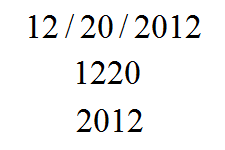
Not only is today a permutation day, but it is also a transposition day! A transposition is a rearrangement that simply swaps too things, like ’12’ and ’20’.
Celebrate Permutation Day by mixing things up! Try doing things in a different order today, or maybe try swapping two things in your schedule to honor today’s transposition!
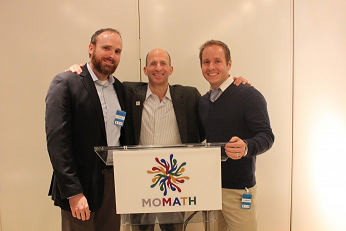 Last night I was named runner-up for the inaugural Rosenthal Prize for Innovation in Math Teaching, presented by the Museum of Mathematics.
The goal of the Rosenthal Prize is to celebrate and promote creative, hands-on teaching methods in mathematics. My work, and that of the winner, will be freely available to teachers through the museum’s website.
The awards were presented last night at MoMath’s “Teacher Preview Night”, so I was able to see the new museum firsthand. There are many amazing exhibits that allow visitors to interact directly with the beauty, elegance, and wonder of mathematics.
I am very proud to have been recognized by MoMath for my work, and after seeing how innovative and creative the Museum of Mathematics is, being recognized by MoMath for innovation and creativity in mathematics teaching is even more meaningful.
This is “The Tree” by Koos Verhoeff et al, on display at the 2012 Bridges Math and Art Conference at Towson University. This piece was named “Best in Show” at the 2012 Bridges Art Exhibition.

Read more about the artists and their work here.
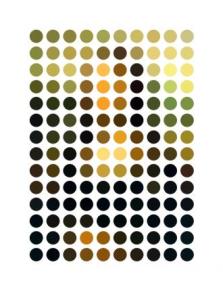 This pointilist images puts me in mind of some fundamental ideas of information theory.
Even though you are seeing a limited set of data here, 140 dots, each of uniform color, it is fairly clear what this image represents. (Hint: standing a bit farther back might help!)
A fundamental concept in information theory is the compression of information. Suppose you want to communicate something, like a painting: a mathematical way to do this would be to describe the color of each pixel, in some order. That would require the transmission, reception, and translation of millions, or even billions, of numbers.
Here we see a very complicated and intricate image being communicated with a very small set of data. Finding more efficient ways to pass along (and store) information is more important than ever before, and is a focus of much modern mathematics.
Of course, recognition of this image relies on the experience of the viewer, who must bring the appropriate context to this information in order to decode it. But that is required in all successful communication.