Regents Recap — January 2014: Systems of Equations

Here is another installment in my series reviewing the NY State Regents exams in mathematics.

Solving systems of equations is a fundamental mathematical skill.  Systems come up in a variety of mathematical contexts, and so they play a natural role in all high school math courses.

It’s not surprising, then, that solving systems of equations appear on all New York math Regents exams.  But what is surprising is how similar the questions on different exams are, given that the three exams span 3-4 years of mathematical learning.

For example, here is a problem from the Integrated Algebra exam.

2014 Int Alg Regents 37

Here is a problem from the Geometry exam.

2014 Geo Regents 9

And here is a problem from the Algebra 2 / Trig exam.

2014 Alg 2 Trig Regents 31

The question from the Integrated Algebra exam is actually harder than the question on the Geometry exam.  Ironically, the directive on the algebra exam is to solve the equation graphically.

The system on the Algebra 2 / Trig exam involves rational expressions and a quadratic equation, but these are skills students are supposed to have in the Integrated Algebra course, which they take 2-3 years earlier.

I have written about this phenomenon before, but it continues to strike me as odd that over the span of 3-4 years of mathematics instruction, this is the growth these tests are looking for.

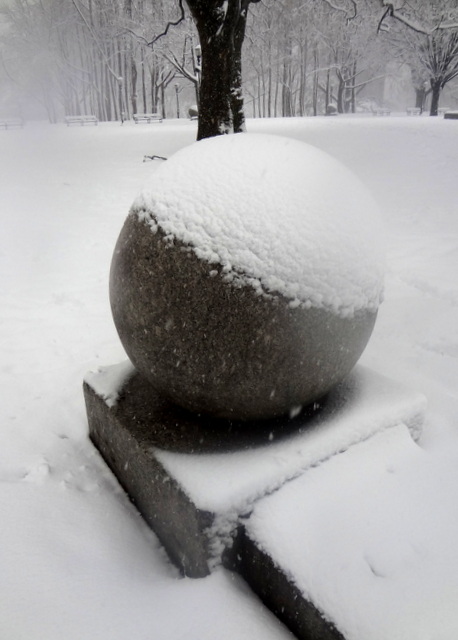
Math Photo: Spherical Snow Cap

On a recent snowy day, I took a stroll through the park at lunchtime.  This lovely round stone caught my eye.

Spherical Cap and Projection

The snow here has accumulated as a spherical cap.  I also like how the area under the stone, untouched by snow, is some kind of projection of the sphere.  I wonder what we can say about the direction of the snowfall, based on this snowless projection?

Related Posts


Regents Recap — January 2014: Fill-in-the-Blank Proofs

Here is another installment in my series reviewing the NY State Regents exams in mathematics.

The January, 2014 Geometry exam included something I had not seen on a Regents exam:  a fill-in-the-blank proof.

2014 Geo Regents Proof 38

While I see some value in these kinds of problems in the teaching of two-column proofs, they shouldn’t be used on the final exam for a Geometry course.  The goal of teaching proof is for students to develop the skills necessary to construct their own proofs from scratch.  This problem reduces “proof” to a series of recall tasks.

So why not just ask the student to construct the proof from scratch?  The rubric suggests the answer to that question.

2014 Geo Regents Proof 38 Rubric

While grading an open-ended proof is hard, checking off a list of six reasons is easy!  Or so you would think.

Reports from colleagues who were grading this problem in a distributed grading center were disheartening.  In particular, there was a lot of disagreement about what constituted appropriate justification in moving from

\frac{RS}{RA} = \frac{RT}{RS}

to

(RS)^2 = RA \times RT

Apparently, teachers in the room wanted to accept “cross multiplying” as a legitimate reason, but would not accept “multiplication property of equality”.  The site supervisor agreed, despite my colleagues’ objections.

Problems like this highlight the tendency to test what is easily tested and graded, not necessarily what’s important.  And grading room stories like this should give pause to those who like to believe that these tests represent objective measures of learning or knowledge.

Follow

Get every new post delivered to your Inbox

Join other followers: