Balancing Act

We’ve been discussing center of mass in class recently.  While this powerful idea extends well beyond its physical interpretation, it’s good to frame the conversation around the idea of balancing objects on their centroids.

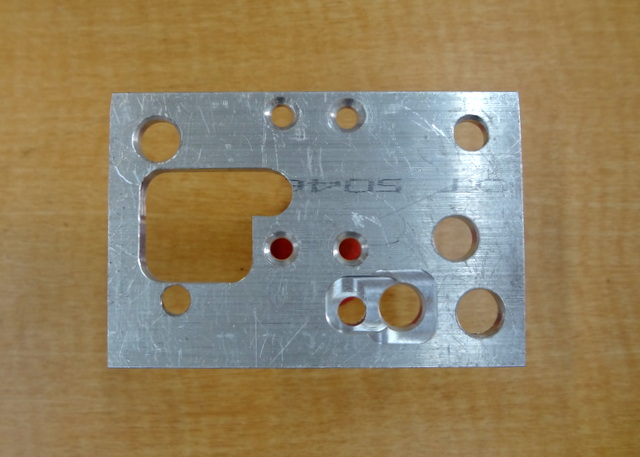
One student was inspired by the claim that all physical objects have centroids, and that they can be found fairly easily.  So he took a small plate of aluminum, drilled a bunch of random holes in it, and tried to find its center of mass.

planar lamina

He claimed he had done it.  But how could we test his hypothesis?  It seemed like there was only one way!

balancing act

It took us a while, and a few attempts, but we were able to do it!  It created a nice little challenge for us, and a nice physical experience with the center of mass.

Math Quiz — NYT Learning Network

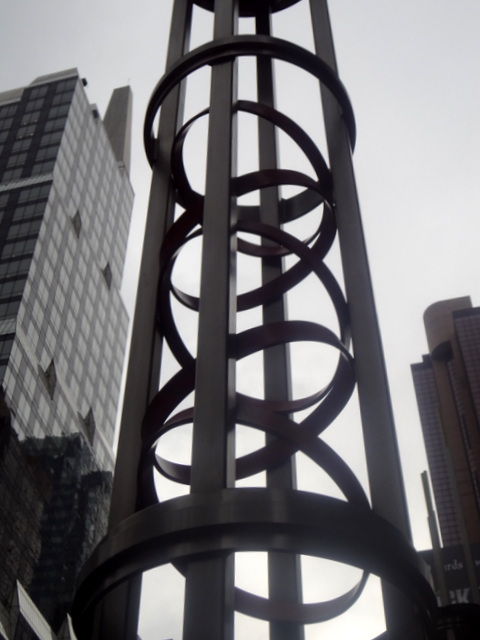
broadway ticket boothThrough Math for America, I am part of an ongoing collaboration with the New York Times Learning Network. My latest contribution, a Test Yourself quiz-question, can be found here

Test Yourself — Math, April 2, 2014

This question refers to an article about how dynamic ticket pricing has put the musical The Lion King back on top of the Broadway box office.  Approximately how many people see the musical each week?

This is Not an Exponential Function

A question from the January 2014 Integrated Algebra Regents exam asks students to identify a graph showing exponential decay.  This graph was the correct choice.
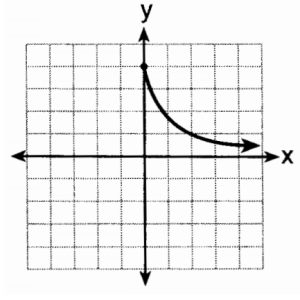
This is not an exponential function

We regularly see terrible graphs on these exams:  non-trigonmetric trig functions, functions intersecting their vertical asymptotes, and unscaled coordinate systems.  So it comes as no surprise that this graph is not actually the graph of an exponential function!

First, note that all exponential functions have the form y = C a ^{kx}.  Since this graph passes through the point (0,4), we immediately see that C = 4.

Note also that the graph passes through the point (2,1).  Thus, y(2) = 4 a ^{2k} = 1.  We can now use this information to compute y(1).

Since 4 a ^{2k} = 1, we see a^{2k} = \frac{1}{4}.  But a^{2k} = (a^{k})^{2}, and so (a^{k} )^{2} = \frac{1}{4}.

Taking the square root of both sides, we see that a^{k} = \pm \frac{1}{2}.   Assuming a > 0, we have a^{k} = \frac{1}{2}, and so 4a^{k} = 2.  But y(1) = 4 a ^{k}, so we now know that y(1) = 2.

Notice, however, that the graph does not pass through the point (1,2)!  Thus, this is not the graph of an exponential function.

Related Posts
Follow

Get every new post delivered to your Inbox

Join other followers: