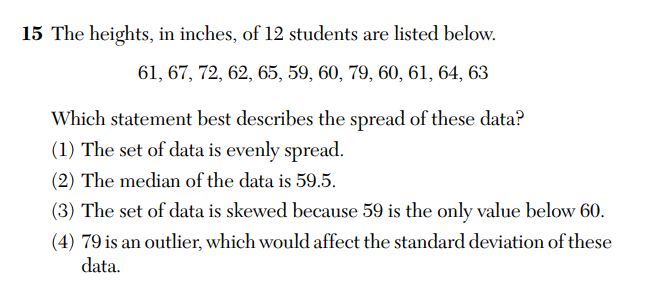
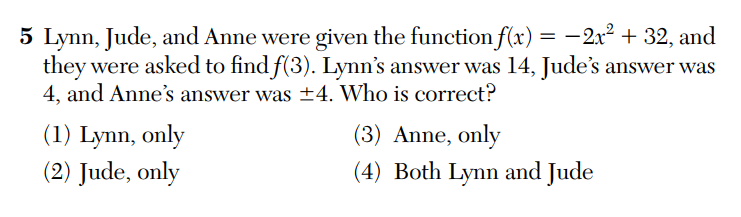
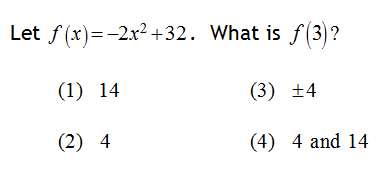
Despite its shortcomings, this kind of question keeps appearing on New York State math exams. This is number 27 from the June, 2017 Common Core Algebra exam.

Here’s an example of a full credit response according to the official model response set provided by the state.
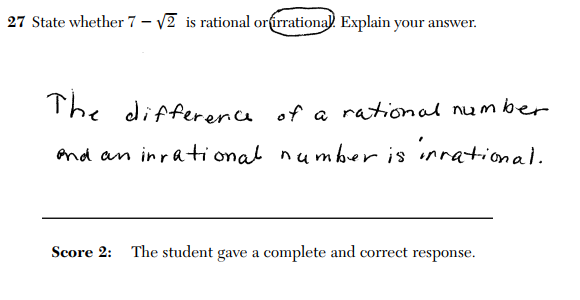 There is no explanation here. The argument is simply It’s True Because It’s True: the difference between a rational number and an irrational number is irrational because the difference between a rational number and an irrational number is irrational. All the student has done is identified one number as rational and one number as irrational (without even identifying which is which) and recited the frequently-tested property.
As scored, this question is designed to test recall of a specific, incidental fact while intentionally avoiding the relevant mathematical content, namely, what it means for a number to be rational or irrational. A second model response that actually demonstrates some mathematical knowledge about irrational numbers earns only partial credit.
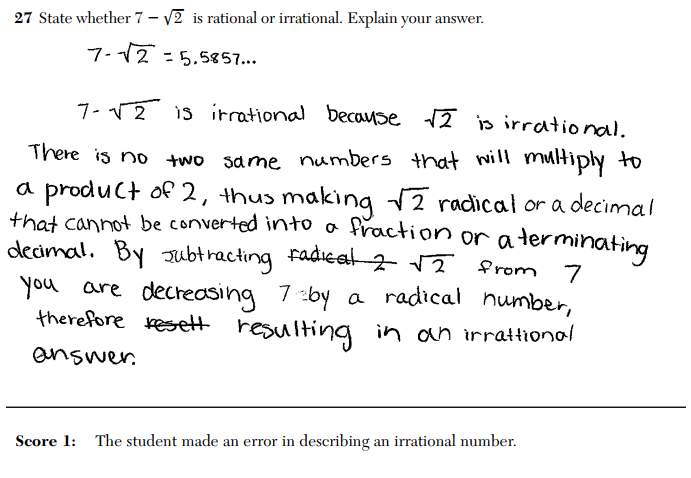
Unlike the student in the first response, or the test makers for that matter, the student here recognizes that the irrationality of the square root of 2 should be established. The explanation isn’t completely correct, but it demonstrates much more understanding than the first response. Unfortunately, as long as questions like this keep appearing on these exams, students and teachers will continue to be rewarded for mindlessly regurgitating what the test makers want to hear.
Related Posts
- Regents Recaps
- Regents Recap — January 2015: It’s True Because It’s True
- Regents Recap — June 2016: What Do They Want to Hear?
- Regents Recap — June 2014: Common Core Algebra, “Explain your answer”