Who Needs Math? A Student Responds

For a political science professor, Andrew Hacker is surprisingly familiar to math teachers.  His 2012 New York Times Op-Ed “Is Algebra Necessary?” generated lots of conversation in the math education community, including several pieces from me:  “N Ways to Use Algebra With the New York Times” in NYT Learning, and “Replace Algebra with Algebra?”.

Professor Hacker is back in 2016 promoting a new book, and in a recent NYT interview he revives his anti-math arguments from four years ago:  math is not really necessary for jobs; it’s too hard; it prevents students from graduating.

I saw the piece and didn’t feel the need to respond.  There was nothing new, and I’d said what I wanted to say here.

But I was pleasantly surprised when I saw this letter-to-the-editor, written by a high school student, published in the February 19th edition of the New York Times.

In “Who Needs Math? Not Everybody” (Education Life, Feb. 7), Andrew Hacker, who teaches quantitative reasoning at Queens College, says that since only 5 percent of people use algebra and/or geometry in their jobs, students don’t need to learn these subjects.

As a high school student, I strongly disagree.

The point of learning is to understand the world. If the only point of learning is job preparation, why should students learn history, or read Shakespeare?

And while your job may never require you to know the difference between a postulate and a theorem, it will almost certainly require other math-based skills, like how to prove something or how to understand a graph.  

And my surprise turned to delight when I realized that the author is a 9th grader in my Geometry class!

While her love of mathematics and her wonderful attitude toward learning certainly predate my Geometry course, I am very proud to see reflections of our classroom in her letter.

You can read the full text of her letter here.

Related Posts


Teaching with “Why Do Americans Stink at Math?”

why do americans stink at mathMy latest piece for the New York Times Learning Network is a math lesson that uses Elizabeth Green’s article “Why Do Americans Stink at Math?” to get students thinking about the most effective ways to teach and learn mathematics.

Is there a crisis in math education? Lots of people seem to think so.

From worries about where the United States ranks on international tests to arguments over the Common Core, the way teachers teach and students learn math continues to be debated widely, leading to proposed changes in the ways mathematics is taught. But what really works for students in the math classroom? And when changes to the techniques are necessary, how can they be implemented effectively and appropriately across an entire system? This Text to Text lesson plan confronts those questions and more.

Students are invited to use the suggested texts, as well as their own experiences in math class, to explore questions like “Do you believe teaching with a stronger emphasis on conceptual understanding will improve students’ performance in math?”, “What are some of the potential obstacles one might face in trying to change the way mathematics, or any subject, is taught?”, and ultimately, “What are the best ways to teach and learn mathematics?”

The entire piece is freely available here.  There are already a number of interesting student comments on the piece.  It’s certainly eye-opening hearing what they have to say about how they perceive effective math teaching.

Exploring Compound Interest

Go to a <a href="http://bucks.blogs.nytimes.com/2013/01/07/investing-money-plus-lots-of-time-equals-excitement/">related post</a> about a topic one blogger calls “incredibly important to share with your kids.” »My latest piece for the New York Times Learning Network is a math lesson exploring personal savings and the power of compound interest.  The piece was inspired by a new program in Illinois that creates an automatic payroll-deduction savings program for all state residents.
In addition to exploring the basic ideas of savings and compounding, students are invited to analyze the merits of this state-run program.

The automatic retirement savings program mentioned in the article is described as a zero-fiscal-cost program because it does not require any government funding to run. This is because the savers themselves pay the costs, in the form of fees to financial institutions, amounting to 0.75 percent of their total savings each year.

Have students compute the costs associated with maintaining the account for each of the typical savers they profiled in the previous activity. One way to do this is to compute 0.75 percent of the total value of the savings account each year, before interest is computed. This is an estimate of the amount that would be paid in fees that year, and thus should be subtracted from the amount in savings.

The entire piece is freely available here.  Hopefully students will get a sense of the power and value of long-term savings, and maybe ask a few good questions about the the true price of zero-fiscal-cost programs.

Exponentials and Ebola

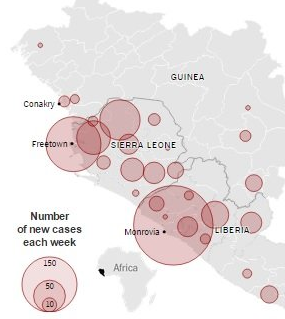
My latest piece for the New York Times Learning Network is a lesson on the underlying mathematics of the spread of contagious diseases, like Ebola.ebola map

In this lesson, students use a basic exponential model to explore the fundamental mathematical ideas of transmission and replication.

Mathematically, the spread of disease can be modeled in a manner similar to the spread of a rumor. Although a number of simplifying assumptions must be made, the simple exponential model captures the basic impact of transmission rates on the dispersion of a disease among a population. Students can explore the consequences of transmission rate using multiplication, algebra, graphing utilities and elementary statistics.

After exploring the essential behavior of various simple exponential models, students then compare real-world data to their theoretical models.  Those that are capable can perform regressions on the data to approximate actual transmission rates.  The students’ work and the real-world data establish a context for discussing the strengths and weaknesses of this simple model of disease transmission.

This lesson is part of a series of Ebloa lessons at the NYT Learning Network and is freely available here.

Exploring Fair Division

fair division triangleMy latest piece for the New York Times Learning Network is a math lesson exploring basic techniques of fair division.

Fair division is concerned with partitioning a set into fair shares.  “Fair” can take on different meanings in different contexts, but at its most basic level, a share is fair if someone is willing to accept it.

This lesson builds on an excellent article in the NYT about a technique in rent-splitting based on Sperner’s Lemma, an important result in Topology.  The author tells the story of how he and two roommates used the technique to settle on a fair division of rent for three different-sized rooms.

“The problem is that individuals evaluate a room differently. I care a lot about natural light, but not everyone does. Is it worth not having a closet? Or one might care more about the shape of the room, or its proximity to the bathroom.

A division of rent based on square feet or any fixed list of elements can’t take every individual preference into account. And negotiation without a method may lead to conflict and resentment.”

After reflecting on the article, students use the related NYT interactive feature to explore the algorithm and then research basic techniques in fair division like divider-chooser, sealed bids, and the method of markers.  The full lesson is freely available here.

Follow

Get every new post delivered to your Inbox

Join other followers: