In class, and on Twitter, I posed a question that led to lots of great conversation.
To increase the volume of a cylinder, is it better to increase the radius or the height? Great conversation starter today.#math #mathchat
— Patrick Honner (@MrHonner) January 9, 2015
There are many reasons I love this particular question. It’s familiar, accessible, and usually counter-intuitive. And it bridges algebra and geometry in a very natural way.
A reasonable response is to argue that an increase in radius will be better. The volume of a cylinder is 
If you imagine the grey cylinder shown below, this argument seems to make sense. Increasing the height a little bit adds a small blue disk of volume to the top, but increasing the radius a little bit adds a large blue shell. The additional volume of the shell clearly appears to be more than that of the disk.
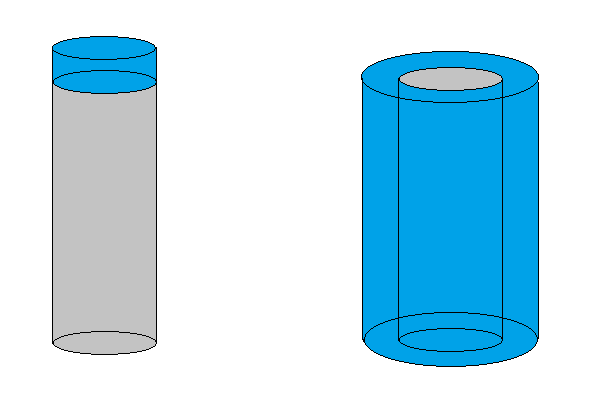 However, this argument is a lot less convincing if you imagine a different cylinder.
 It’s not obvious which additional volume here is larger, which suggests some further thinking is in order. At this point, some multidimensional extreme-case thinking usually leads to an appropriate conclusion: Namely, that the answer depends on the dimensions of the cylinder.
This problem is my standard introduction to partial derivatives. It creates great context for computing and comparing


But its versatility is another reason I like this problem so much. Geometry and Calculus students can both engage in this problem in a meaningful way, using the tools available to them to analyze the situation. And it always results in great conversations!