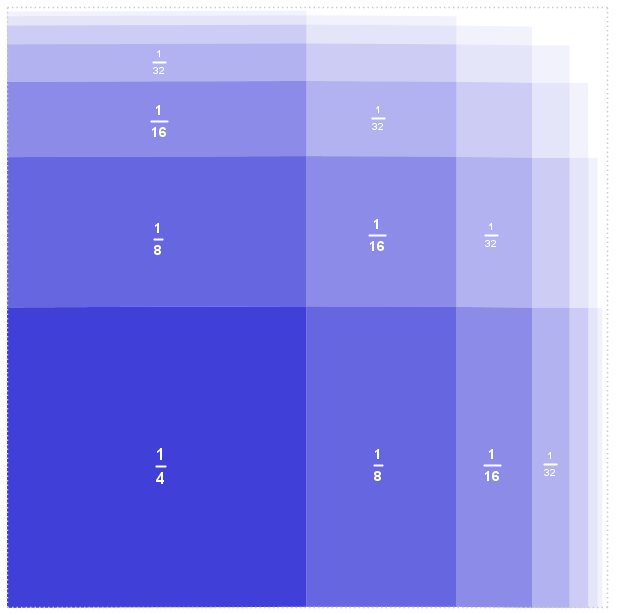
Now, let’s see a similar 3-dimensional proof that 1/8 + 3/16 + 6/32 + 10/64 + 15/128 + … = 1
MrHonner
· April 30, 2013 at 11:24 am
I will leave that as an exercise for the reader.
Mike Lawler
· May 2, 2013 at 6:42 pm
Here’s two attempts at the 3d visual proof that 1/8 + 3/16 + 6/32 + 10/64 + . . . = 1 using Lego Digital Design. It was neat to see the cube coming together while building this. The first video is the first three terms, and the 2nd is the first 5.
JIm Loy sums the series on his website, using partitions: http://www.jimloy.com/algebra/aseries.htm A standard approach would be
S = (1/4)(1+2x+3x^2+4x^3+…) where x = 1/2.
S = (1/4)(d/dx(x+x^2+x^3+…))
= (1/4)(d/dx(x/(1-x)))
= (1/4)(1/(1-x)^2) where x = 1/2,
as I’m sure you are aware.
A snow day snow array! I thought of punching out that one stubborn entry, but let it be in the spirit of wabi-sabi. It’s like the Great British Baking Show’s missing raspberry. Related Posts
I’ve always found it cool that if you double the smaller acute angle in a 3-4-5 triangle you get the larger acute angle in a 7-24-25 right triangle. You can see this as a consequence Read more
Here are some images from Harpa, in Reykjavík, Iceland. Harpa is home to the Iceland Symphony Orchestra and the Icelandic Opera, and is one of the most mathematical buildings I have ever seen. The face Read more

5 Comments
Graeme McRae · April 30, 2013 at 10:25 am
Now, let’s see a similar 3-dimensional proof that 1/8 + 3/16 + 6/32 + 10/64 + 15/128 + … = 1
MrHonner · April 30, 2013 at 11:24 am
I will leave that as an exercise for the reader.
Mike Lawler · May 2, 2013 at 6:42 pm
Here’s two attempts at the 3d visual proof that 1/8 + 3/16 + 6/32 + 10/64 + . . . = 1 using Lego Digital Design. It was neat to see the cube coming together while building this. The first video is the first three terms, and the 2nd is the first 5.
https://www.youtube.com/watch?v=F0nvNtuKQBA
Graeme McRae · May 2, 2013 at 7:04 pm
I love it!
Nat Silver · May 10, 2013 at 8:30 pm
JIm Loy sums the series on his website, using partitions:
http://www.jimloy.com/algebra/aseries.htm A standard approach would be
S = (1/4)(1+2x+3x^2+4x^3+…) where x = 1/2.
S = (1/4)(d/dx(x+x^2+x^3+…))
= (1/4)(d/dx(x/(1-x)))
= (1/4)(1/(1-x)^2) where x = 1/2,
as I’m sure you are aware.