Which Triangle is More Equilateral? 2012 Edition
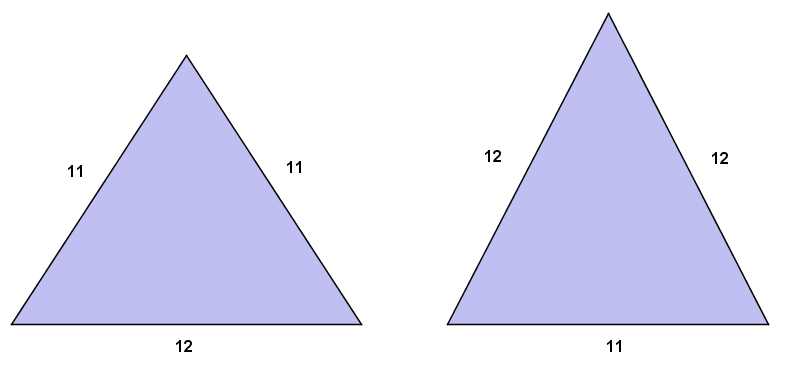
In honor of the passing of two consecutive Isosceles Triangle Days (11/11/12 and 11/12/12), let us revisit an old favorite: which of these triangles is more equilateral?
Related Posts
- Which Triangle is More Equilateral?
- Which Triangle is More Equilateral? Part II
- Another Equilateral Comparison
- An Ode to Equilateralism
60 Comments
David Patterson · November 12, 2012 at 10:11 am
I’ve seen your other posts on this and thought I’d give it a shot.
My idea: Find the area of one of the triangles. (Use Heron’s formula.) Find the length of a side of an equilateral triangle with the same area. Find the ratio of that side with the average of the sides of the original triangle.
When I did this:
11-11-12: 0.9972…
11-12-12: 0.9976…
So the 11-12-12 triangle would be more equilateral.
I haven’t tried other cases…I’ll let others pick apart my idea. 🙂
Below is a simple Python script to do my calculations:
import math
s1 = 11
s2 = 11
s3 = 12
p = (s1+s2+s3)/2.0
A1 = math.sqrt(p*(p-s1)*(p-s2)*(p-s3))
a = math.sqrt(A1*(4.0/math.sqrt(3)))
answer1 = a/((s1+s2+s3)/3.0)
print answer1
MrHonner · November 12, 2012 at 11:24 am
I like that strategy (and love the python code!). This sounds roughly equivalent to my approach to the same question last year, although I’m not it’s identical. Might be interesting to explore where they differ.
David Patterson · November 12, 2012 at 3:24 pm
I ran a quick check of all the triangles with integer side lengths between 1 and 20. I ran my formula and the formula you had written before. Both of our formulas ordered the triangles in the same sequence. The range of my equation was ~0.36 to 1. The range of your equation was ~.12 to 1. I like your formula better because 1) it is simpler, and 2) it spreads the values out more
If someone would like to try their own equation…you can use this Python script and a spreadsheet program.
import math
maxLen = 20
for s1 in range(1,maxLen):
for s2 in range(1,maxLen):
for s3 in range(1,maxLen):
if s1+s2<=s3 or s2+s3<=s1 or s3+s1<=s2:
continue # not a triangle!
p = (s1+s2+s3)/2.0
A1 = math.sqrt(p*(p-s1)*(p-s2)*(p-s3))
a = math.sqrt(A1*(4.0/math.sqrt(3)))
answerDP = a/((s1+s2+s3)/3.0)
answerMH = A1/((math.sqrt(3)*((s1+s2+s3)/3.0)*((s1+s2+s3)/3.0))/4.0)
print s1,s2,s3, answerDP, answerMH
MrHonner · November 12, 2012 at 3:39 pm
Very cool. Sounds like a great student project in the works! Thanks for sharing your work, David.
David Patterson · November 13, 2012 at 9:59 am
LOL…I just did the algebra…my formula simplifies to the square root of your formula. Ok…I’m done for now. 🙂
Nat · November 14, 2012 at 4:30 pm
I started by saying ‘of course not’ but having read your explanation I am getting the hang of it.
So by that token, can you extend the analogy to two ellipses of 11 and 12 and 12 and 11 (I mean the radii on horizontal and vertical axis)?
I guess not. What are you going to compare the area of the triangles with; an equilateral triangle with the same area for each figure respectively OR an equilateral triangle with the same area assuming the base to match with the two sides?
Let me explain this further; In the first case you calculate the area of each triangle and compare the length of that ideal triangle to the current one (as one of the solutions on the original site has it). On the other hand you could also compare the area to a new one where the length of the differing side is forced to be equal with the remaining two.
It could also be any other parameter. So in essence I feel you cannot have one triangle being ‘more’ equilateral than the other.
Correct me if I am missing something here
MrHonner · November 14, 2012 at 5:37 pm
We’ve proposed several potential measurements of equilateralness (equalaterality?), including those you referenced from last year. Your objection seems to be that there is no one clear measurement, and thus we can’t really answer the question “Which triangle is more equilateral?”
I understand that objection, but there are lots of ideas in mathematics where disagreement preceded an ultimate consensus on the natural definition.
What I like about this question is that it invites us, and students, in to such a debate! What could be more mathematical?
Nat · November 14, 2012 at 11:23 pm
I see your point :).
On that note, I like to think of the problem as a book sliding on a surface i.e. imagine the equal sides as being a part of a book that is gradually sliding apart on the surface. So the problem would be which of these two is fast approaching equalaterality. Well… that leads us to think deeply to define equalaterality (or rather not, since definition is already implicit in this approach).
But then the problem could also be twisted as ‘what if the book sides were uneven and they were sliding to other side?’. I guess there is no easy answer 🙂
Ihor charischak · November 12, 2012 at 11:09 am
11-11-12 is my guess. I took the average of the 3 sides and found that each side of the 11-11-12 triangle was closer to their average than the 12-12-11 triangle.
MrHonner · November 12, 2012 at 11:29 am
Mean deviation of the side lengths? I like it! Although we might run into problems if we compare an 8-10-12 triangle with a 9-9-12 triangle: I think the mean deviation is the same in both cases. Are these two triangles equally equilateral?
Bob · November 15, 2012 at 1:42 am
An 8-10-12 triangle is not equilateral at all, so it must be less equilateral than any a-a-b triangle. But the question is, can a-b-c and d-e-f triangles be more or less equilateral?
MrHonner · November 15, 2012 at 6:31 am
So an 8-10-12 triangle is less equilateral than a 100-100-1 triangle? I don’t agree with that!
eddi · November 12, 2012 at 3:08 pm
Patrick, I love this question. The route I followed was based on the idea of “squareness” (which I got from the Balanced Assessment people). Rather that focus on area, I focused on the height of the respective triangles (from the off-side, so it is symmetric), and compared the ratio of height to base. For an equilateral triangle, the ratio is the familiar .8660 (sqrt3/2); for the 11-11-12, it is .7683, for the 12-12-11, it is .9696. The 11-11-12 triangle has 11.28% error from the equilateral, the 12-12-11 has 11.95% error. (I used Geometer’s Sketchpad for these calculations).
Thanks for the idea!
Eddi
MrHonner · November 12, 2012 at 3:44 pm
Looking at height-base ratio is an interesting idea. At first I thought that ignoring the other height would be troublesome, but what’s cool here is that if you know that the height and base are both relative to the vertex angle, you actually know the other two sides (and, essentially, the other height). So that information is all wrapped up in your metric!
Very cool! Worth more exploration.
mr bombastic · November 12, 2012 at 5:11 pm
Hmm… I guess I think the 12,12, 11 would “look” more equalteral in the same way that a 1000 & 1000 & 999 side length triangle would look even more equilateral. Your eye is less likley to notice one side is shorter because it is shorter by a smaller percentage.
mr bombastic · November 12, 2012 at 5:28 pm
Doh, didn’t notice there where actual triangles to look at. To my eye the 11, 11, 12 looks more equilateral, but that just has to do with the orientation of the triangle. I have noticed that if I try to free hand a square in word or geogebra or whatever, I am always quite a ways off – the “square” is never tall enough.
MrHonner · November 12, 2012 at 9:01 pm
Fawn Nguyen remarked today on Twitter that the orientation of the triangle may affect our perception. We may see the base as more important than the sides.
And yes, an interesting, and connected, project might involve people “free drawing” equilateral triangles and then see how close they get, or what they are actually closer to.
James Cleveland · November 18, 2012 at 11:28 pm
I agree with that. Because I looked at this on my iPad, I could easily turn the screen and see the triangles in different orientations. My gut originally told me that the 11-11-12 was more equilateral, but when I looked at it from the other angles, I didn’t see one as more so than the other.
James Lindsay · November 14, 2012 at 12:04 am
I’d argue for calculating the point of intersection of the three altitudes and comparing it to the centroid (center of mass). Whichever is closer is “more equilateral.” The mathematician in me, though, balks at this terminology. Neither is more equilateral as neither is equilateral. 🙂
MrHonner · November 14, 2012 at 6:40 am
A cool idea. Interesting that you choose to compare the orthocenter (altitudes) and the centroid (medians). What about the circumcenter and incenter? I think an interesting follow-up would be to explore what kinds of triangles have, say, orthocenters and centroids that are close together, but with incenters that are far from the two.
And, yes, the triangle is equilateral or it isn’t, but one of the best things about mathematics is playing around with definitions!
Cammyjb · November 14, 2012 at 12:38 am
I looked at it from an angle perspective. Which is problematic, as in triangles, the angles all add up to 180 degrees. I then thought, how does one find a root mean square? Maybe that might help. Maybe I don’t have to square root it, maybe just the sum of the squares.
So I totalled the squares of the number of degrees in a triangle, 3 x 60^2 = 10800.
Then I decided, what if the top angle of these isosceles triangles (the odd angle) were 2 degrees larger or smaller, and found that 59^2 + 59^2 + 62^2 = 10806 = 61^2 + 61^2 + 58^2.
I generalised this result to:
If the top angle = 60 – theta, then for any value of positive theta, the sum of the squares of the angles is the same for negative theta, and hence both triangles have the same “equilaterality”.
As theta -> 0 the triangle becomes more equilateral.
Therefore, I conjecture that the triangle with the angle at the top closest to 60 is more equilateral.
Cosine Rule, not going to type it all out, but:
For the triangle on the left, I found the top angle to be 66.1 degrees. Theta = 6.1
For the triangle on the right, I found the top angle to be 54.6 degrees. Theta = 5.4
Hence, I conclude the triangle on the right, with sides 11-12-12 to be more equilateral.
MrHonner · November 14, 2012 at 6:52 am
First of all, thanks for sharing that 59^2 + 59^2 + 62^2 = 10806 = 61^2 + 61^2 + 58^2. That is really cool!
Second, I like the idea of looking at the “distance from 60” in that vertex angle. However, one thing this approach lacks, I think, is a clear path to comparing all triangles. This method seems to be good for isosceles triangles, but how might we compare, say, a 9-9-13 triangle with a 9-10-12 triangle?
Cammyjb · November 14, 2012 at 7:32 am
After further calculation, I found that any combination of angles which weren’t 60-60-60 when their squares were summed, they are all greater than 10800.
The reason the theta works for isosceles is that I only had to vary the vertex angle to vary the sum of the squares of the angles. If you summed the squares of the angles in the one with vertex angle 66.1, the value would be larger than the value for 54.6. This was my real point.
Because this works for any value of any angle, I would generalise to say that the sum of the squares of the angles in a triangle is always greater than or equal to 10800, but only at 10800 is it equilateral.
I might even name this value its equilaterality. The closer to 10800, the more equilateral. The value of the triangle on the right is 10843.7 and the left triangle is 10855.8. The right triangle is more equilateral, and because they’re isosceles, it happens to vary with the vertex angle.
So now this can be generalised to all triangles.
To answer the following:
Triangle A, with angles 1, 60, 119
Triangle B, with angles 59, 60, 61
Triangle A: 17762
Triangle B: 10802
My answer is Triangle B is more equilateral.
MrHonner · November 14, 2012 at 7:36 am
Very cool, and great(and clear) explanation of your thought process. I think you are one or two steps away from inventing standard deviation!
raf dahouk · November 14, 2012 at 5:04 am
use the cosine rule to find all angles and average them out. whichever is closer to 60 wins!
MrHonner · November 14, 2012 at 6:43 am
One problem with this approach: which of the following is more equilateral?
Triangle A, with angles 1, 60, 119
Triangle B, with angles 59, 60, 61
Johan Lindgren · November 14, 2012 at 9:23 am
One could argue that because none of the triangles are Equilateral, therefore none of them are “More Equilateral” than the other. It’s like saying “Which is more solid, coffee or tea?”
MrHonner · November 14, 2012 at 11:29 am
True, but it can be fun (and productive!) to explore a less rigid notion of equilateralness.
And I bet there are plenty of ways to measure the “solidity” of liquids!
Johan Lindgren · November 14, 2012 at 10:24 am
The sum of all the sides for each triangle.
T1: 11 + 11 + 12 = 34
T2: 11 + 12 + 12 = 35
Each triangle have 2 sides that are equilateral.
T1: (11 + 11) / 34 = 64,7 %
T2: (12 + 12) / 35 = 68,6 %
Triangle 2 wins by 68,6 % of the total length of the sides being equilateral.
MrHonner · November 14, 2012 at 11:30 am
It looks like a 13-13-9 triangle would be more equilateral than both of them!
Johan Lindgren · November 15, 2012 at 3:33 am
Haha, point taken! 🙂
Mike Naylor · November 16, 2012 at 2:50 am
I like James Lindsay’s approach! I think it may yield very similar results to my idea: Circumscribe a circle around each triangle. Whichever triangle takes up a greater proportion of the area of its circle is more equilateral.
My guess by looking is that the 11-11-12 is more equilateral — it just looks more equilateral to me.
I sketched it up on GeoGebra and found the 11-11-12 occupies 41.3462% of the area of its circle while the 11-12-12 covers just 40.8727%. Winner is the 11-11-12. Interesting that the best possible score, by an equilateral triangle, is 41.3464%, meaning the 11-11-12 has an equilateralness rating of 99.9994%. Very close! The 11-12-12 rates a 98.8543%… no slouch either, but not as equilateral.
MrHonner · November 16, 2012 at 5:21 pm
Very interesting approach! And sensible, too. I wonder how it compares to my approach from last year: https://mrhonner.com/2011/10/12/which-triangle-is-more-equilateral-part-ii/. Something tells me that the two methods would produce an equivalent ranking of triangles.
Brian · November 20, 2012 at 4:47 pm
The Circumscribed Equilateralness, if I may call Mr. Naylor’s approach that, yields (64 Area^3)/(3⎷3 (abc)^2), whereas your “Perimetrized” Equilateralness gives (36 Area)/(⎷3 (a+b+c)^2). More invariant expressions. 🙂 Now there’s the question of whether there are ever two triangles such that the two approaches rank them differently.
l hodge · November 17, 2012 at 4:17 pm
It does not seem like the choice of units should affect the “equilateralness” of a triangle – i.e. it shouldn’t matter whether we measured in inches or feet or any other unit. So, if you ratio up the 11,11,12 triangle to a 12, 12, 13.1 triangle, the equivalent question becomes whether a 12, 12, 11 or a 12, 12, 13.1 triangle is more equilateral.
@Mike, are you sure on those percentages? I got different values with a slightly higher percentage for the 11,12, 12 (41% vs 40.9%).
MrHonner · November 17, 2012 at 7:56 pm
I, well, WolframAlpha, got 40.97%.
Mauricio · November 18, 2012 at 2:21 am
I believe that the most equilateral triangle will be a triangle whose Standard Deviation closest to 0. For example, a triangle whose sides are 12-12-12 has a SD of 0, this is a perfect equilateral triangle. Given a triangle with angles 90,60,30 has a mean of 60, however, such triangle has a SD of 30 which is not equilateral at all.
In this situation,
11-11-12 has a SD of 5.29228 while a triangle with sides 12-12-11 has a SD of 4.71204.
Therefore, by this argument, the triangle with sides 12-12-11 is more “equilateral.”
A more complex situation will develop when the “squareness” of a quadrilateral has to be determined. For example, given the sides 11-11-11-12, how square can this quadrilateral be. Since a quadrilateral with given sides has infinite many combinations of angles, we will have to solve for the angles that give us the smallest standard deviation. In this problem, I believe that we will have to end up using calculus to determine the optimal situation.
Mauricio · November 18, 2012 at 2:35 am
Actually, with this approach I am not checking its “equilateralness” but rather its “equiangularness.” In the case of a triangle, both mean the same, however, for an n-gon a rectangle the SD of its angles is 0 but it could be far away from being a square.
MrHonner · November 18, 2012 at 9:11 am
Yes, it’s a good point about equilateralness vs equiangularness. We get away with not worrying about it here because, of course, the conditions are equivalent for triangle. But as you point out, equiangularness is something very different from equilateralness in quadrilaterals.
To be honest, what I’m really thinking about is regularness. But because I originally phrased the question about triangles, it came out as a question about equilateralness.
Mauricio · November 18, 2012 at 9:59 am
If it is about regularness, then we have to take into account sides and angles. The mean of sides is the length of the side of a regular polygon with the same perimeter. If we take the standard deviation of the sides, then which polygon will have more regularness given that the units of the standard deviations are different.
Now another approach is using area. Will optimizing the area of the polygon such that the area is the closest to the area of the polygon with same perimeter take care of both sides and angles?
MrHonner · November 18, 2012 at 3:55 pm
Last year I took an approach similar to your second suggestion, but instead of comparing it to the appropriate regular polygon, I just compared it to the most regular object of all.
l hodge · November 18, 2012 at 9:53 am
We could think of triangles as points in 3D space: triangle 11,11,12 is the point (11,11,12) in the XYZ coordinate system. An interesting side question is what part of 3D space would be filled by points corresponding to various types of triangles and what sort of symmetry would you see.
If we think of triangles as points, we could measure the distance between a triangle and the nearest equilateral triangle using the generalized Pyth. Th. (distance formula). It is not a lot of work to show that the “nearest” equilateral triangle has side lengths equal to the mean of the original triangles side lengths.
Similar triangles should have the same “equilateralness” rating. So, let’s only look at points (triangles) that have a distance of 1 unit from the origin. Or, equivalently, divide the distance to the nearest equilateral triangle by the “size” of the triangle (distance from the origin). The formula for the rating:
[(a-d)^2 + (b-d)^2 + (c-d)^2]^.5 / [a^2 + b^2 + c^2]^.5 where
d is (a + b + c)/3
Another option is to use a different measure of distance. You could say the “distance” between the triangles with side lengths a,b,c & d,e,f is |a-d| + |b-e| + |c-f|. In this case, the “nearest” equilateral triangle will have side lengths equal to the 2nd largest side length of the original triangle. The “size” of the triangle, or “distance” from the origin, is the perimeter. Using this method, the “nearest” equilateral triangle may well have a different perimeter than the original triangle.
The (12,12,11) triangle is more equilateral by both of these measures.
The symmetry involved makes it irrelevant which coordinate we use for which side length.
Using points and the usual distance formula has a lot in common with the standard deviation methods that others have suggested.
MrHonner · November 18, 2012 at 3:58 pm
Love the idea of thinking of the triangles as points in space. You are suggesting something like a “best fit” line [x = y = z] from which to judge arbitrary triangles. And maybe even create a new metric on space, as you suggest! Really cool stuff.
Hadley · November 19, 2012 at 12:15 am
You could also think about how this method generalises to 3d spaces generated by other parameterisations of triangles: e.g. two length + one angle, one length + two angles. What shape does the subspace of equilateral triangles form? How do you find the closest equilateral triangle and how do you measure the distance?
Colin Beveridge · November 19, 2012 at 2:29 am
Oo, I like this — how about the angle between the line OT (where T is the point) and the line OC (where C is (1,1,1))?
This also gives (12,12,11) as the equilateraller of the two.
MrHonner · November 19, 2012 at 6:41 am
It would be fitting to use a different angle to quantify equiilateralness of triangles, I suppose! Using the angle between the point at the line should be equivalent to the distance to the line, right? The triangle “points” determine a right triangle in space, and so using the angle opposite a leg should be the same as using the length of the leg.
Hadley Wickham · November 19, 2012 at 8:13 am
I think that’s the cosine dissimilarity metric 😉
Brian · November 20, 2012 at 5:02 pm
If we add the condition that the scale of the triangle shouldn’t matter, we are talking about measures on all lines through 3-D space, i.e. . Then symmetry suggests that we add an orbifold condition by letting
  , the symmetric group on 3 letters, act on
  . I’m not sure what that is off the top of my head, but it’s an enlargement of the moduli space of triangles. Note that not all points in space would make a triangle and that some definitions of equilateralness given here will extend to all triples, but any that use Heron’s formula for area will give imaginary results. For actual triangles, one would want to restrict to the open cone T = {(a,b,c) inR^3| b + c > a, a + c > b, a + b > c} (see http://staff.science.uva.nl/~heinloth/StacksSeminar/MarcelloGereon.pdf ).
Brian · November 18, 2012 at 10:50 pm
Another interesting connection to your and other solutions are invariant polynomials. Let P_n:=a^n+b^n+c^n. Your equilateralness solution, up to a factor I probably got wrong, is sqrt(27((P_2)^2-P_4)/(P_1)^4), a (square root of the) ratio of two 4th degree invariant polynomials. Perimeter=P_1 is one such invariant polynomial, as is the radicand of Heron’s formula. The Sine law ratios can be given an interpretation in terms of Heron’s formula and invariant polynomials. The point of using such polynomials is that they are invariant under permutation of a, b, and c.
Extension: What do other expressions of invariant polynomials of the triangle sides tell you about the triangle? Can all such invariant polynomials be written in terms of the P_n, i.e. as sums of powers of the sides?
MrHonner · November 19, 2012 at 12:16 am
An interesting connection, to invariant (symmetric) functions. I guess it makes sense that our proposed measures of equilateralness are all symmetric functions, as there is no reason to consider the sides to be different in any way.
And that’s a great way to extend a question: once the exploration has produced some abstractions, start asking new questions about the abstractions!
secretseasons · November 19, 2012 at 11:07 am
Very interesting problem!
I really liked a couple commenters’ suggestion that you circumscribe the triangle with a circle, then find the ratio of the triangle’s area to the circle’s area.
But it occurred to me that this is mathematically elegant but (I think) equivalent to “circumscribing” the triangle with *any* regular n-gon. So why not use a square?
1. Take the sides and order them longest to shortest, longest side is “a”
2. Compute the area of your triangle (Heron’s formula)
3. Compute the area of a square with sides a.
4. Take ratio of triangle’s area to a^2.
An equilateral triangle has a ratio of 43.3% in this way of doing it, and it’s unit/scale invariant, and this technique gives the triangle on the right as the more equilateral (which seems to be the emerging consensus).
I think this is the same as the circumscribed circle method but maybe easier to compute and visualize (because the longest side of your triangle is already drawn for you and it’s the side of your square).
MrHonner · November 19, 2012 at 12:15 pm
An interesting idea, and the virtue here is that finding the area of the square is [a bit] easier than finding the area of the circumscribing triangle.
The unit-less-ness is certainly someething we want, but I wonder about the consequences of relying on the longest side. I feel like we might be able to exploit that to create some weird comparisons.
David Patterson · November 19, 2012 at 2:02 pm
The original question asks “which triangle is more equilateral”. To be elegant, it would be nice to have a method that works for all polygons.
This is where it gets tricky. Equilateral triangles happen to be regular as well, but if we decide that equilateralness is the only thing we care about, then our solution, to be elegant, must not depend on equiangularness!
This leads to weird questions like: Which polygon is more equilateral…a four sided rhombus like polygon with sides 3-3-3-4 with a 60 degree angle between two of the sides with length three, or a 3-3-4 triangle. 🙂 Should we (can we) just use a statistical measure of the lengths of the sides that doesn’t care about how many sides there are?
Apologies to the purists following this thread who are cringing at this point. Actually, everyone is probably cringing at this point.
Henry Segerman · November 19, 2012 at 8:41 pm
Extending the circumscribing circles idea, my suggestion for “equilateralness” would be the ratio of the radiis of the circumscribed and inscribed circles.
Mauricio · November 19, 2012 at 8:46 pm
circumscribing the polygon in my opinion is a valid way to tackle it for a triangle, however, for an n-gon this will not work. in order for a quadrilateral tu be able to be circumscribed, it must be cyclical which may or may not be the best estimate.
Theron Hitchman · November 19, 2012 at 8:57 pm
I’m late to this party… but I had two ideas for measurements.
The first is inspired by the area and symmetry comments I read above. (Sorry, I didn’t read all of them. I got inspired and decided to do some math instead.) Consider the set S of points obtained by reflecting the original triangle over each of its three angle bisectors. Then use the ratio Area(S)/Area(T). Your triangle is equilateral if and only if this ratio is 1. So maybe make a “distance” by taking the difference of this ratio from 1.
Another neat way would be to use the distance between the incenter and the orthocenter. A triangle is equilateral if and only if those two points are the same. The trouble with this one is that it is not scale invariant. If you dilate the whole picture, that distance will change, but the relative shape is not really different. So maybe use the ratio of this distance to the perimeter of the triangle.
MrHonner · November 20, 2012 at 11:46 am
I love the idea of “symmetrifying” the object, and then comparing the original object with the “symmetrified” version. Had never thought of anything like that: thanks for sharing! Is there a particular reason you suggested the angle bisectors, as opposed to, say, the perpendicular bisectors? Or the medians?
Someone else suggested the incenter/orthocenter difference, which I think gives rise to interesting questions like “What kinds of triangles have incenters and orthocenters 2 units apart?”
l hodge · November 19, 2012 at 11:55 pm
A couple of thoughts on the more general case – “regularness” for hexagons for example:
One possibility is to dump the hexagon on the coordinate plane and “fit” a regular hexagon. One measure of best fit might be to minimize the sum of the distances (or the squares of the distances) between the vertices of the original hexagon and the vertices regular hexagon. Adjust the sum of the distances or sum or the squares by a scale factor to get your “regularness” rating. Use a regular hexagon with parameters for shifting left/right, up/down, dilation, and rotation like this: http://www.geogebratube.org/student/m22497
Another option is to get coordinates for the vertices of the hexagon and use these to think of the hexagon as being a point in 12 dimensional space: (x1,y1,x2,y2,…,x6,y6). Then use some measure of distance to see how close the given hexagon is to a “point” corresponding to a regular hexagon. I wonder how the usual measure of distance (Generalized Pyth Th.) would compare to the previous method. Does it make a big difference if we compare individual coordinates instead of vertices?
Gary Rubinstein · May 14, 2013 at 1:55 pm
I was thinking that if the first triangle were rotated along the base into the third dimension, after a certain number of degrees it would appear to be equilateral to an observer further back. Likewise the second triangle would need to be rotated along its base ‘back’ behind the plane of the screen. The triangle that requires the smaller rotation to appear equilateral is the one that is more equilateral. I haven’t worked out the details on this, though, or know if there is another parameter needed, like the distance from the observer to the screen.
Gary Rubinstein · May 14, 2013 at 1:58 pm
This idea might just work for comparing different isosceles triangles where the legs are larger than the bases. Another idea is for the left hand triangle the base could move back until the triangle appears equilateral while in the right hand triangle the base has to more forward. The one that requires the smallest amount of movement to appear equilateral is more equilateral.