
I’ve read that there are over 500,000 manhole covers in New York City, but I’d never noticed these pentagonal bolts before. A nice mathematical surprise among the grit and grime.
I’ve read that there are over 500,000 manhole covers in New York City, but I’d never noticed these pentagonal bolts before. A nice mathematical surprise among the grit and grime.
Here is another installment in my series reviewing the NY State Regents exams in mathematics.
June, 2014 saw the administration of the first official Common Core Regents exam in New York state, Algebra I (Common Core). Roughly speaking, this exam replaces the Integrated Algebra Regents exam, which is the first of the three high school level math Regents exams in New York.
The rhetoric surrounding the Common Core initiative often includes phrases like “deeper understanding”, and the standards themselves speak directly to students communicating about mathematics. These are noble goals.
So, when it comes to the Common Core exams, it’s not surprising that we see directives like “Explain how you arrived at your answer” and “Explain your answer based on the graph drawn” more often.
But including such phrases on exams won’t accomplish much if the way the student answers are assessed doesn’t change. Here’s number 28 from the Algebra I (Common Core) exam, together with its scoring rubric.
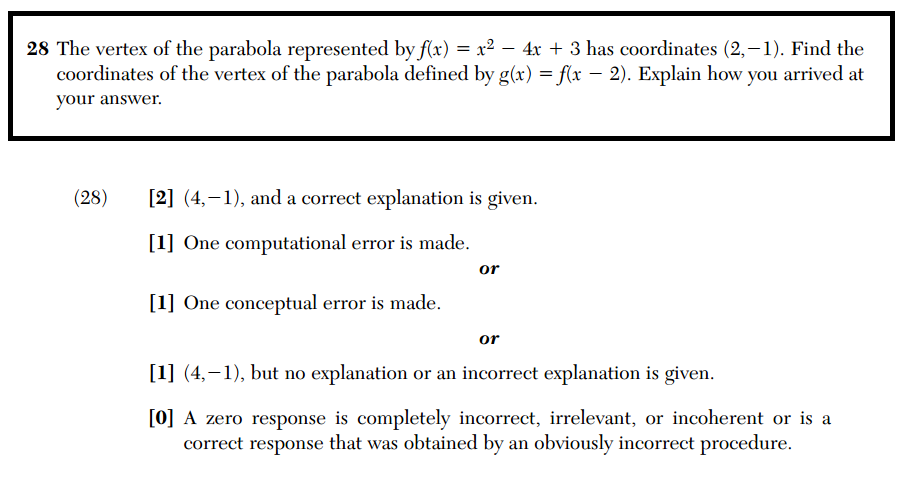
Notice that the scoring rubric gives no indication as to what constitutes a “correct explanation”. When scoring these exams, groups of readers are typically given a few samples of student work and discuss what a “correct explanation” looks like. But people grading these exams often have drastically different ideas about what constitutes justification and explanation. Given the importance Common Core seems to attach to explanation, I’m surprised that the scoring rubric takes no official position here. In fact, this rubric is essentially identical to those used for the pre-Common Core Integrated Algebra exam.
There’s a real danger in simply tacking on generic “Explain … / Describe …” directives to exam items. Consider number 34 from the Algebra I (Common Core) exam.
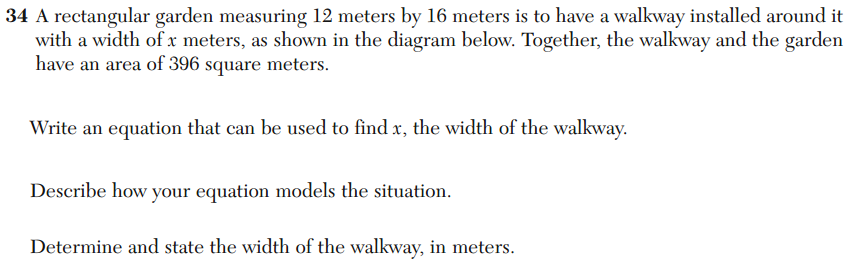
It’s not really clear to me what a valid response to the directive “Describe how your equation models the situation” would look like. Nor an invalid response, for that matter. So what do students make of such of a directive? I suspect that, for many, it just becomes another part of the meaningless background noise of standardized testing, another place where they simply have to guess what the test-makers want to hear. And according to the rubric, the test-graders will have to guess, too.
Yes, students should be communicating about mathematics, their processes, and their ideas. But just adding “Explain how you got your answer” to a test question isn’t going to do much to help achieve that goal.
Related Posts
 Math for America is an outstanding professional organization that focuses on training and retaining high quality math and science teachers. MfA is running an ongoing series of profiles on Facebook on members of their community, and I am proud to be one of the subjects.
One of the best aspects of being a part of the MfA community is the depth and variety of opportunities for real professional growth. Here’s a quote from my interview:
“You can always find something that interests you, that will align with what you’re doing, or that will challenge you to think differently about what you’re doing. It’s always thoughtful, it’s always real, and it’s always a great experience.
You can see the entire profile here.
Math for America has been active in reshaping the mathematics education community in New York City for the past 12 years, and now operates in several cities nationwide. MfA also serves as a model for state Master Teacher programs, which are emerging across the country. It has had a substantial impact on my career, and the career of many colleagues, and I’m proud to be an active part of the community.

Sometimes the sun and surroundings cooperate and create an opportunity for a perfect profile picture.
Related Posts
Here is another installment in my series reviewing the NY State Regents exams in mathematics.
June, 2014 saw the administration of the first official Common Core Regents exam in New York state, Algebra I (Common Core). Roughly speaking, this exam replaces the Integrated Algebra Regents exam, which is the first of the three high school level math Regents exams in New York.
The Algebra I (Common Core) exam was structured differently than the Integrated Algebra exam. Algebra I (Common Core) contained 24 multiple choice questions, while Integrated Algebra contained 30 multiple choice questions. This change, in and of itself, likely translates to lower average scores on the Algebra I (Common Core) exam: merely guessing on those 6 extra multiple choice questions would yield an extra 3 points on average, and multiple choice questions are generally easier to score points on than free response.
The free response sections are structured slightly differently, as well, but not substantially so. In fact, apart from some significant content differences, not much distinguishes the new Common Core exam from the old Integrated Algebra exam.
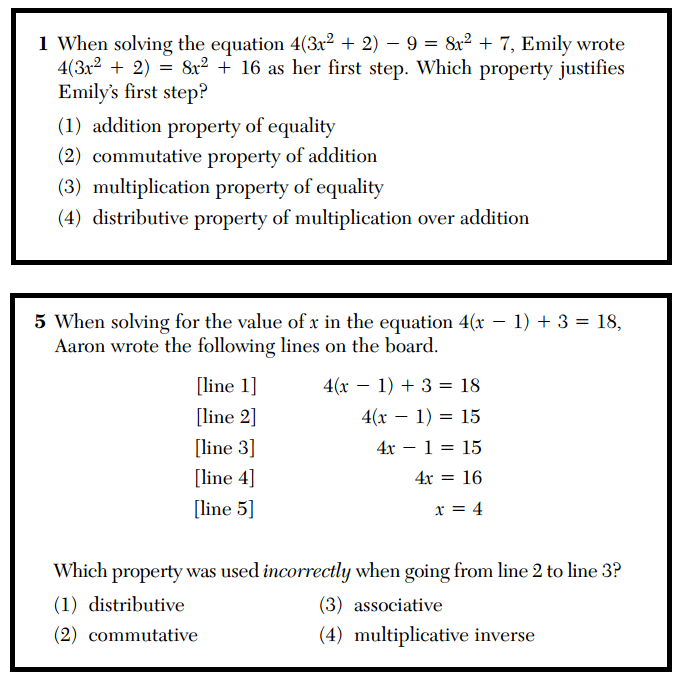
Many of the questions on the Algebra I (Common Core) exam are similar in style and content to questions on other math Regents exams. For example, here is number 1 from the Common Core exam compared with number 5 from the Integrated Algebra exam.
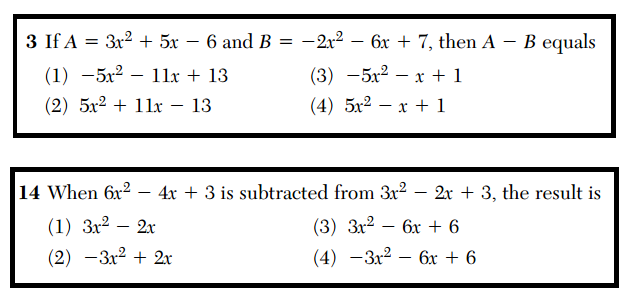
And here is number 3 from the Common Core exam compared with number 14 from the Integrated Algebra exam.
A few of the questions on the Algebra I (Common Core) exam do show improvement over similar items on other exams. Consider number 8 from the Common Core exam, compared with number 8 from the Integrated Algebra exam.

The two questions address the same issue, but the top is more mathematically precise. (I really dislike the “Which step could be used?”-type problems).
Overall, in terms of the way questions and posed and structured, there is not much of a difference between the new and old exams. The Algebra I (Common Core) exam is pretty much standard test fare. When the current testing culture is criticized, a common response is that we just need to make better tests. This is easy enough to say, but surprisingly hard to do. And it doesn’t look like this first Common Core Regents exam is substantially different, or better, than its predecessor.