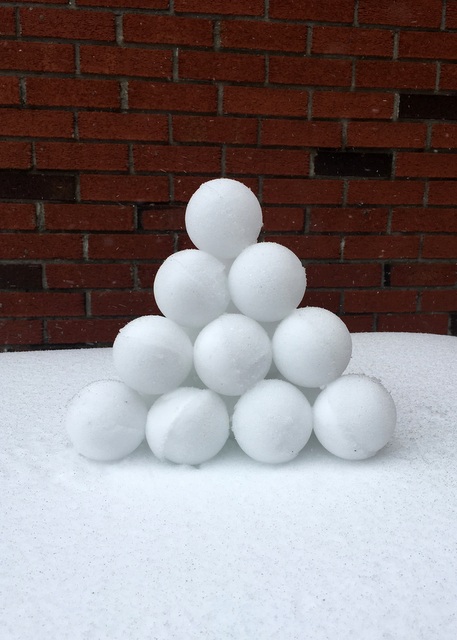
I put the recent snow day, and a snowball maker, to good use!
Related Posts
I put the recent snow day, and a snowball maker, to good use!
Related Posts
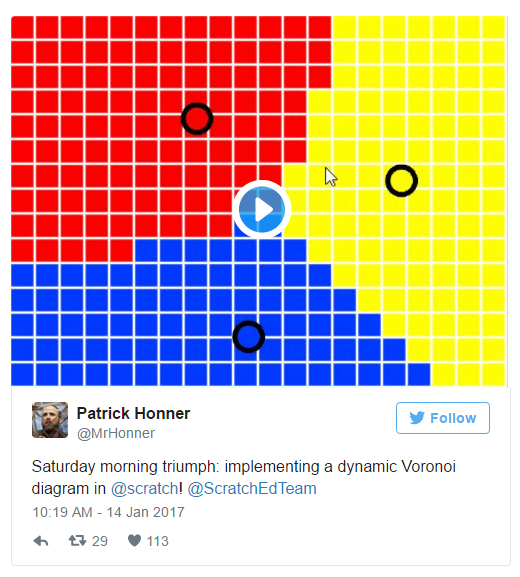 Scratch Ed, an organization at the Harvard Graduate School of Education that supports teaching and learning with Scratch, recently profiled some of my work teaching mathematics using Scratch.
The article, Making Math with Scratch, highlights a Math for America workshop I ran for teachers that centered on approaching mathematical concepts through the lens of coding and computer science. Several projects I use in my classroom are featured, and I also discuss why I like teaching with Scratch and how it’s become a valuable part of my approach to teaching math.
The purpose of the workshop and Patrick’s classroom activities are to demonstrate the power of bringing mathematics and computer science together. “Ultimately the goal is to show how math and computer science are great partners in problem solving. And Scratch provides a terrific platform for that.”
I’m excited to share the work I’ve been doing with math and Scratch over the past few years–including talks and workshops at conferences like Scratch@MIT, SIAM ED, and the upcoming NCTM Annual meeting–and I really appreciate this nice profile from Scratch Ed.
You can read the full article, Making Math with Scratch, at the Scratch Ed website.

What catches my attention in this photo, after the blue and white squares, is how the beams slowly bend away from center. I suppose knowing the size of those beams, and some trigonometry, would allow you estimate the location of the camera.
On a visit to the Lowline, I noticed an interesting application of mathematics above us.
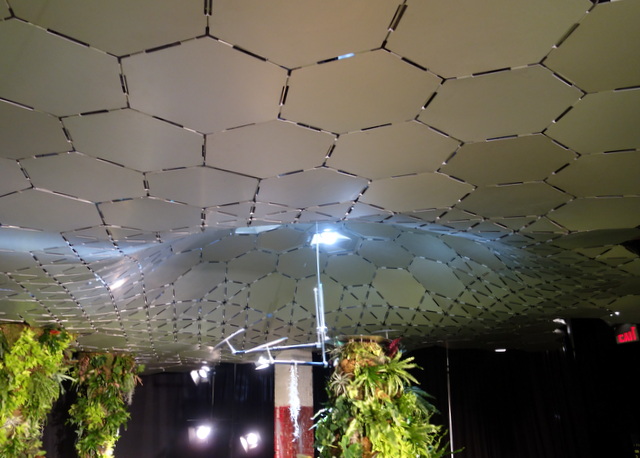
The ceiling is a tiling of hexagons and equilateral triangles. But unlike a typical tiling of a flat bathroom floor, this tiling seems to create a curved surface! Here’s a closer look:
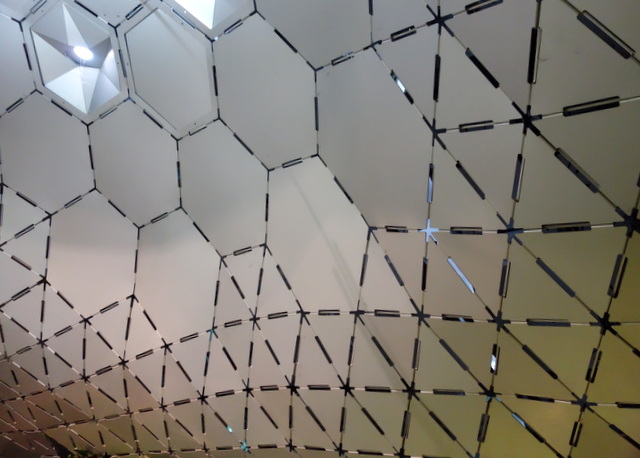
The underlying pattern is hexagonal, but when a hexagon is replaced with six small, hinged equilateral triangles, the surface gains the potential to curve.
It’s interesting to follow the “straight” line paths as they curve over the surface. And since this tiling is suspended from above, it’s interesting to think about what the surface would look like if it were lying on the ground. How “flat” would it be? Or a better question might be “How far from flat is it?”
 Donors Choose, with support from the Simons Foundation and the Overdeck Family Foundation, has launched the Science Everywhere Innovation Challenge.
Teachers are invited to design innovative, hands-on math and science projects that will engage and excite students outside of school, and then submit those projects through DonorsChoose.org. Eligible projects will receive matching funds from the Simons and Overdeck Foundations, and the top five entries will win an additional $5,000 in classroom funding.
Winners will be determined by a panel of judges led by astronaut and author Leland Melvin. I am proud to be one of the teachers on the panel, and I’m excited to see the cool projects submitted by classroom teachers from around the country!
You can read about the Science Everywhere Innovation Challenge here and find all the participation details at the Donors Choose website here.