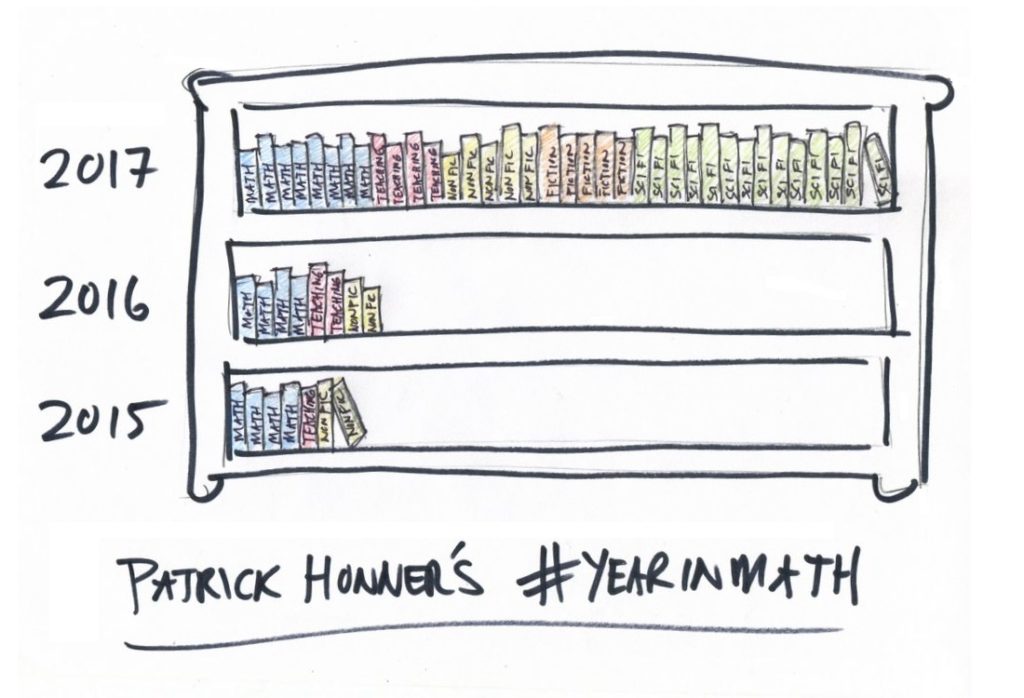
I kept up last year’s trend of reading more books, though I didn’t read quite as many as I did in 2017. Here are some of the books that made me think, and kept me thinking, in 2018.
The Dispossessed, by Ursula Le Guin, was the most satisfying book I read in 2018. I didn’t know much of Le Guin before her passing in January, and I received some terrific recommendations from Nalini Joshi and Ben Orlin. I read The Left Hand of Darkness, The Lathe of Heaven, The Word for World is Forest, and a book of her short stories. I finished up with The Dispossessed, a complex and exciting story about a scientist on the verge of a momentous discovery, and his attempt to bring two worlds in opposition back together.
Merchants of Doubt, by Naomi Oreskes and Erik Conway, is an eye-opening account of the highly coordinated efforts of powerful interests to discredit the science of tobacco and, ultimately, science itself. The same machinery, and in many cases, the exact same people, have been used against the science of acid rain, ozone depletion, and now, climate change. The following quote from Adlai Stevenson appears in the book and has stuck with me: “The trouble with Americans is that they haven’t read the minutes of the previous meeting.“
On Writing Well, by William Zissner, had the most impact of any book this year. With humor, precision, and of course, great writing, Zissner offers concrete advice on how to be a better writer, while dispelling the romantic ideal of writing as a conduit of inspiration. He had me at “The essence of writing is rewriting.”
Algorithms to Live By, by Brian Christian and Tom Griffiths, is a wonderful non-technical tour of the most important algorithms and procedures affecting our lives. It’s filled with useful metaphors and real-world connections, but it’s technical enough to provide lots of inspiration for my computing class. Thanks to Jeremy Kun for this recommendation.
I continued to read a lot of science fiction in 2018. One book that really stuck with me is Slade House, by David Mitchell. Months after finishing, I’m still recalling scenes and moments from the story. And I was happy to start reading Octavia Butler in the latter half of the year, including Bloodchild and Other Stories, which I found unexpected and compelling.
Lastly, though I’d read parts of it before, I finished a complete (re-)reading of How People Learn this year. Published by the National Academies, How People Learn is a comprehensive summary of the state of the art in the science of learning circa 2000. Those selling the “disruption” of education could learn a lot from this book, as many of their “innovations” have been tried before. And those looking for real progress in education should read this book, too (which is freely available for download here). How People Learn II, a recently released update, is on my list for 2019.
I’m looking forward to another year of good books, so please offer some recommendations if you’ve got them!
Related Posts