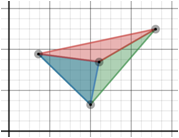
At first it bothered me, but now I appreciate the slow deformation of quadrilaterals from top left to bottom right in this coordinate system, centered at the sun.

At first it bothered me, but now I appreciate the slow deformation of quadrilaterals from top left to bottom right in this coordinate system, centered at the sun.
On Tuesday, October 8th, I’ll be hosting a webinar for the Global Math Department, a volunteer organization run by math teachers for math teachers. The Global Math Department produces weekly webinars and newsletters that share what math teachers around the world are doing in and out of the classroom.
I’ll be hosting “A Computational Approach to Functions”, my latest talk at the intersection of mathematics and computer science education. Here’s the description:
Looking for a new approach to teaching domain and range? Or an opportunity for students to use their crossover computer science skills? Taking a computational approach to functions allows for the rigorous development of all the fundamental concepts in an active and creative way, while at the same time offering endless opportunities to extend deeper into both mathematics and computer science. If you teach about functions—and what math teacher doesn’t?—you will leave with something new to think about for your math classroom.
The webinar is free and will run from 9 – 10 pm, and a recording will be available after the fact for those unable to attend live. You can find out more information, and register, here.
UPDATE: The full video of the webinar has been posted here.
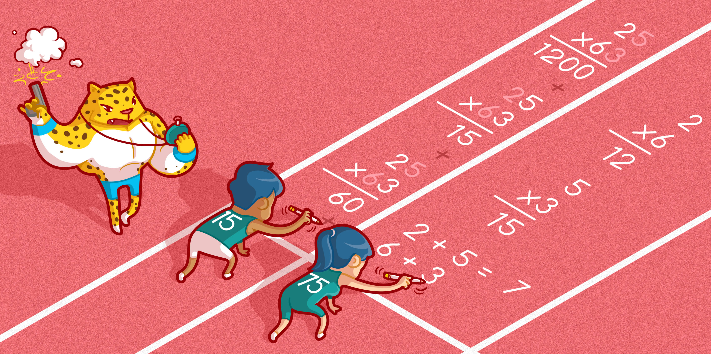
Did you get caught up in the latest viral math problem, 8÷2(2+2)?
The problem here is simply how we interpret the division symbol. Does ÷ mean divide by the one number right after it or by everything after it? This isn’t much of a concern for most mathematicians, as they don’t use this symbol very often. Ask them to solve this problem and they’ll probably just make the whole thing into a multiplication problem: Once you choose to write it as either
or
,
the ambiguity is gone and the answer is clear. As a multiplication question, this isn’t particularly interesting.
But one multiplication question mathematicians do find interesting may surprise you: What is the best way to multiply?
And what is the best way to multiply? The answer may surprise you! Find out by reading my latest column for Quanta Magazine, freely available here.

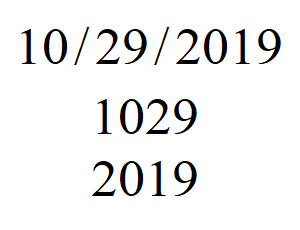
Today we celebrate a Permutation Day! I call days like today permutation days because the digits of the day and the month can be rearranged to form the year.

Celebrate Permutation Day by mixing things up! Try doing things in a different order today. Just remember, for some operations, order definitely matters!
Today we celebrate a Permutation Day! I call days like today permutation days because the digits of the day and the month can be rearranged to form the year.

And not only is it a permutation day, it’s a palindrome day! Thinking of the date as 9/12/19, we can write 91219, which is a palindrome–a number that reads the same backward and forward. Enjoy the day by rearranging something or doing something backwards! Or perhaps even both.