The Crooked Geometry of Round Trips — Quanta Magazine

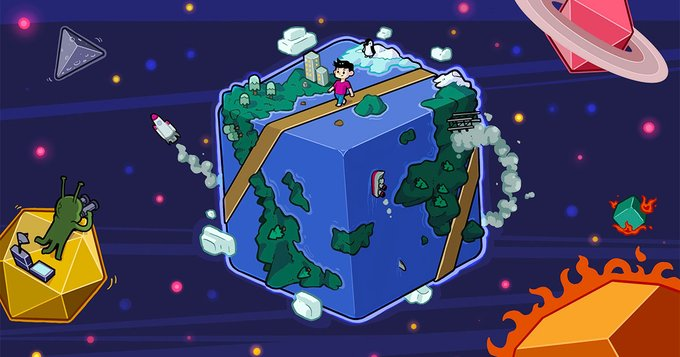
My latest column for Quanta Magazine explores what round-the-world trips would look like if we didn’t live on a sphere.

Have you ever wondered what life would be like if Earth weren’t shaped like a sphere? We take for granted the smooth ride through the solar system and the seamless sunsets afforded by the planet’s rotational symmetry. A round Earth also makes it easy to figure out the fastest way to get from point A to point B: Just travel along the circle that goes through those two points and cuts the sphere in half. We use these shortest paths, called geodesics, to plan airplane routes and satellite orbits.

But what if we lived on a cube instead? Our world would wobble more, our horizons would be crooked, and our shortest paths would be harder to find.

Classification of geodesic paths on platonic solids didn’t happen until relatively recently, and the case of the dodecahedron offers quite a surprise! To learn more, read the full article here.

Forgetting How to Teach

The holiday break brought some much needed time off. I felt refreshed as I returned to work, but my first day back was a bit disorienting.

I opened my agenda and my SMART Notebook, but forgot to open my lesson plan. I forgot to assign my Geogebra classroom activities ahead of time. I forgot to print out my rosters. I forgot to share my screen. I forgot to check if I was muted.

The muscle memory of teaching I had worked so hard to rebuild had faded after 11 days of vacation. I suppose that’s what vacation’s for, but it’s been many years since I’ve been caught off guard like that after a break.

By the end of the week things it felt like we were back to normal again. In school, at least.

Related Posts

Proof in a Poem

Inspired by Hannah Hoffman, here’s a poem proof of the irrationality of the square root of 2.

Suppose that root 2 could be taken to be
The integer a over the integer b
Where a and b have no factor in common
So nothing divides both the top and the bottom

Some algebra that’s quite easy to do
Gives a2 is equal to b2 times 2
But if a2 is even, so too must be a
Now each a in a2 has a 2 in our play

So a2 in fact has a factor of 4
But since this equals 2b2 we can say more
This b2 must now have a factor of 2
And just as above we know b has one too

It appears that we are now able to say
That 2 divides b and 2 divides a
But common factors were assumed to be none
So this contradiction shows we are done

Be sure to check out the excellent efforts of Timothy Gowers and Joel David Hamkins as well.

Here’s the original tweet.

Why Are You Still Here?

It was the last day of school in 2020 and my students were in breakout rooms finishing up a group quiz on quadrilaterals. Class was nearly over, and they were free to log off and head to their next class as soon as they pressed “Submit”.

I noticed one breakout room had only two students in it, which was odd as students were placed in groups of four. Why were these two finishing the quiz without the help of their groupmates? I popped in to see what was going on.

I saw two of my students looking relaxed and comfortable on their screens. “Where are the others?” I said, with some accusation. “They left,” replied the remaining students, without any of the indignation warranted by the situation. Maybe I could help them find their anger: “Why aren’t they helping you finish?” I was not prepared for the answer.

“Oh, we’re done. We already submitted.”

It took me a moment to re-process the situation. “So, why are you still here?”

“We’re just hanging out,” they said. “We’re using your breakout room to talk.” Suddenly I felt like a nosy parent in my own Zoom meeting.

One of my biggest concerns at the start of this year was how we would build connections in remote learning. I’m trying my best, but the culture and social dynamic of our classroom is nothing like it would be in person. In evaluating this aspect of my work, I don’t feel like a success.

But to see my students take a moment after class to socialize made me a feel a little better. After twenty minutes of arguing about squares and rhombuses, they wanted to connect a bit more. And they found a way. Perhaps we all will.

Related Posts

2020 — Year in Review

At the risk of making the understatement of the decade, it has been a challenging year. But 2021 offers promise along multiple dimensions. So with a hopeful eye toward the near future, here’s a review of very busy professional year.

Everything about teaching changed in the past 9 months. In March, COVID-19 sent New York City into Emergency Remote Learning. In September, we returned to schools still adapting to the pandemic. Writing about both experiences has been helpful for me: First, my unprepared reaction to going all remote in the Spring, and later, my adjustment to becoming a fully-remote live teacher in the Fall. It’s all made my second year at a new school seem like Year Five. But we are getting through it.

The biggest professional honor of the year for me came with the publication of “The Best Writing on Mathematics 2020” from Princeton University Press. It’s still a bit shocking to see my article “On Your Mark, Get Set, Multiply” featured alongside the work of incredible mathematical communicators like Steven Strogatz, Erica Klarreich, John Carlos Baez, and others.

The article was originally published in Quanta Magazine, and I explored many fun topics in my column this year, like how social distancing is a geometry problem, the power of assigning impossible problems in math class, and how we still can’t answer simple-sounding questions like “What’s the biggest shape of diameter one?“.

I also continued to write for the New York Times Learning Network in 2020, publishing “Dangerous Numbers” and “7 Ways to Explore the Math of the Coronavirus with the New York Times“. As a result of those pieces, I was interviewed for an NPR piece about teaching about the coronavirus (and received a surprising message from an old friend because of it!)

For obvious reasons, 2020 was the year of the webinar, and I gave talks, ran workshops, and participated in a variety of virtual panels this past year. This summer I participated in NCTM’s 100 Days of Professional Learning with “Coding Math at a Distance“, and ran “A Crash Course in Geogebra” through Math for America to help teachers prepare to teach geometry remotely. This fall I was invited to contribute to NCTM‘s first-ever Virtual Conference, spoke about computer science education at a PAEMST Alumni Webinar, talked Stats in the STEM Classroom as part of joint program between the Museum of Mathematics and Brookhaven National Laboratory, and participated in a panel discussion on math and media literacy during Media Literacy Week. And even though it feels like we’ve been quarantining for years, I actually travelled to Rutgers in February to give my talk “Math Outside the Bubble” in person.

I continued to review books and manuscripts for various publishers, and read a good deal in 2020 as well. I also stayed connected to the mathematical art community, working with organizations like Bridges Math and Art and the Journal for Mathematics and the Arts. I even had some of my photography on display in a exhibit alongside some of my favorite mathematical artists.

I also took advantage of some down time this summer to redesign my personal web page, PatrickHonner.com, and I updated my Speaking and Writing pages. As usual, the new year is already filling up with new and interesting opportunities, but I’m always open to inquiries and can be contacted here.

It was a full and fulfilling professional year, but like much of the world I’ll be glad to put 2020 behind us. Here’s wishing our optimism for 2021 is justified.

Related Posts

Follow

Get every new post delivered to your Inbox

Join other followers: