Clever Carton Accounting

It is a well-known marketing principle that you’ll make more money charging the same for less than charging more for the same amount.

So I wasn’t too surprised when I noticed that something had changed about my usual 64-ounce carton of orange juice.
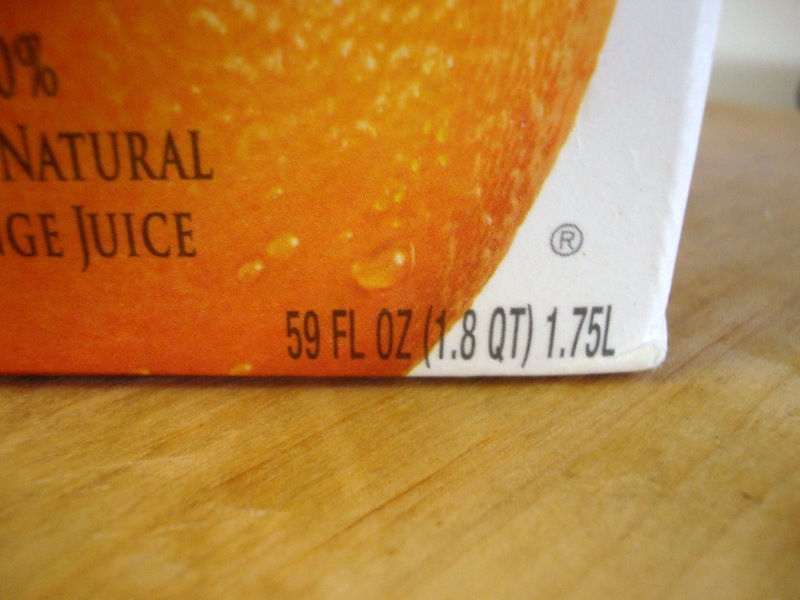
oj-closeup

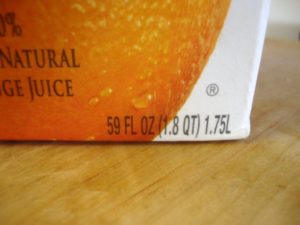
Instead of raising the price of the 64-ounce carton of orange juice from $3.99, the good people at Tropicana just reduced the amount of orange juice I’d get by 5 ounces.  At the old price, orange juice cost around 6.25 cents per ounce.  At the new price, it costs about 6.78 cents per ounce.  That 5 ounce drop in quantity is effectively an 8.5 percent price increase!

I’m sure Tropicana knows that if they raised the price of a 64-ounce carton of orange juice to $4.33, some people would think twice about buying it.  People are comfortable paying $3.99 for their product, and they might be uncomfortable paying $4.33 for it.

Instead, by reducing the amount, the company can effectively raise the price without disturbing the consumer’s comfort level.  And since people pay more attention to price than they do to quantity, most consumers probably won’t even realize they are paying more.

And just in case they might notice, why not keep the carton the exact same size?

Related Posts
 

Fun With Folding: Circumcenter

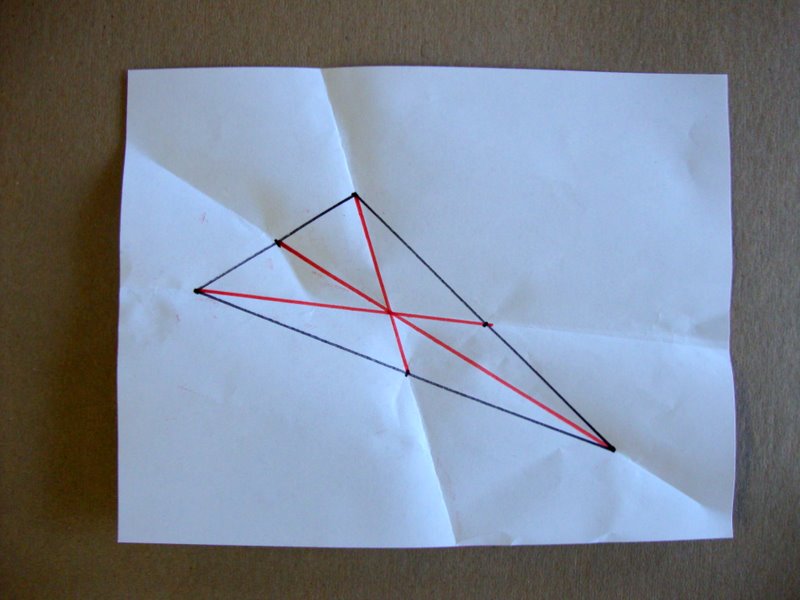
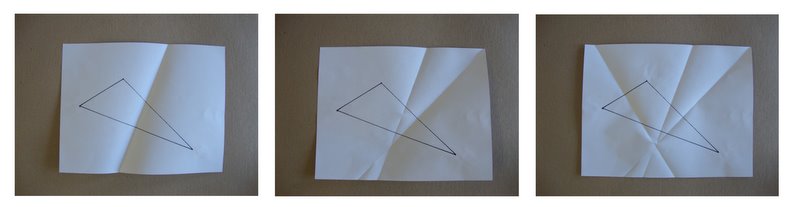
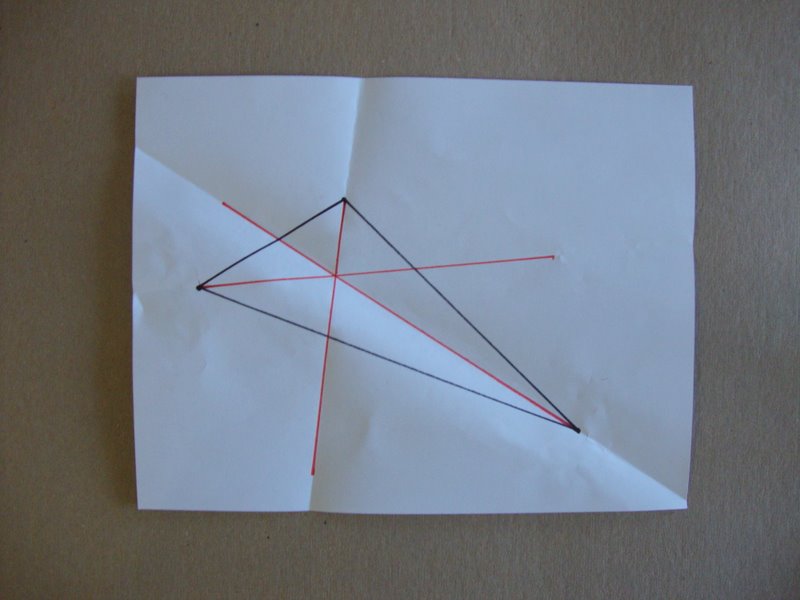
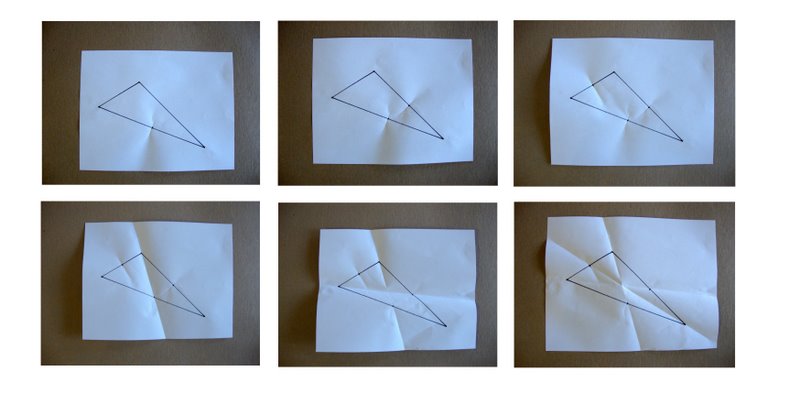
Here’s another entry from my Fun With Folding series:  folding the circumcenter of a triangle!  The circumcenter of a triangle is the center of the triangle’s circumscribing circle.

To fold your way to the circumcircle, use the perpendicular biscctor fold three times to construct the perpendicular bisector of each side of the triangle.  (Click here to find instructions for these basic folds.)

Like magic, all the perpendicular bisectors intersect at the circumcenter!

Be sure to try some other fun mathematical activities with folding!

Have more Fun With Folding!

Fun With Folding: Incenter

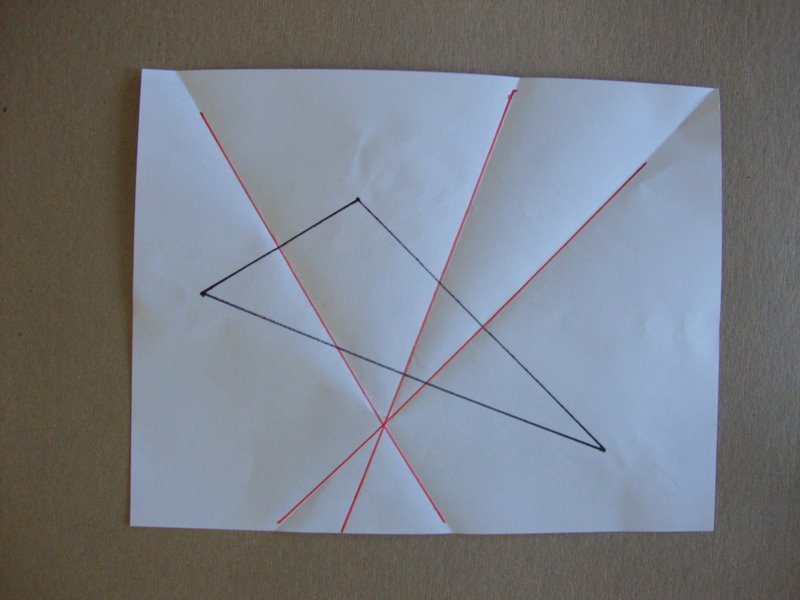
Here’s another entry from my Fun With Folding series:  folding the incenter of a triangle!  The incenter of a triangle has a lot of interesting properties, most of which are related to the fact that it is the center of the triangle’s unique inscribed circle.

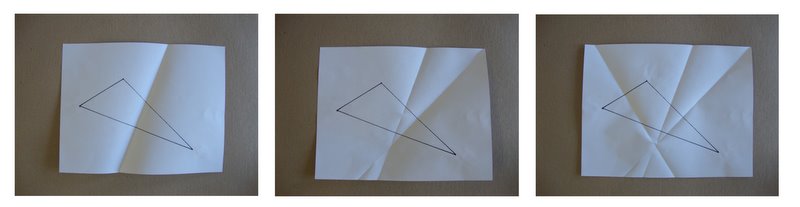
To fold your way to the incenter, start with an arbitrary triangle and use the angle bisector fold on each angle.  (Click here to find instructions for the basic folds.)

Like magic, all the angle bisectors intersect at the incenter!

Be sure to try some other fun mathematical activities with folding!

Have more Fun With Folding!

A Curious Geometric Limit

Inspired by Alexander Bogomolny (@CutTheKnotMath) and his curious geometric limit, I offer this trigonometric approach.

Consider the following diagram in which we have circle X of radius 3 centered at (3,0) and circle O of radius k centered at the origin.  Call the intersection of the these circles in the first quadrant B.  Let A be the intersection of circle O with the y-axis, and extend line AB until it intersects the x-axis at E.  Our goal is to show that \lim_{kto}OE=12.

Consider the diagram below.

a-curious-geometric-limit

Let \angle{OXB} = \theta.  Some simple angle chasing, using properties of isosceles triangles and right triangles, gives us that \angle{OEA} = \frac{\theta}{4}.

Since AO = k by definition, we have tan(\frac{\theta}{4}) = \frac{k}{OE}, and so OE = \frac{k}{tan(\frac{\theta}{4}) }.

Since OB = k is the base of isosceles triangle OXB, we can drop an altitude from X to OB and find that sin(\frac{\theta}{2}) = \frac{\frac{k}{2}}{BX} = \frac{\frac{k}{2}}{3}.    This gives us k = 6sin(\frac{\theta}{2}) .

So OE =  \frac{k}{tan(\frac{\theta}{4}) } =  \frac{6sin(\frac{\theta}{2})}{tan(\frac{\theta}{4}) }.  By the double angle formula for sine, we have

sin(\frac{\theta}{2}) = 2sin(\frac{\theta}{4})cos(\frac{\theta}{4}),

Making this substitution, and by writing tangent as the quotient of sine and cosine, we get

OE = \frac{6sin(\frac{\theta}{2})}{tan(\frac{\theta}{4}) } = \frac{12sin(\frac{\theta}{4}) cos((\frac{\theta}{4}))}{\frac {sin(\frac{\theta}{4})}{cos(\frac{\theta}{4})} } = 12 {(cos(\frac{\theta}{4}))}^2.

Finally, since \theta\to 0 as k \to 0, we have

\lim_{k\to 0}OE = \lim_{\theta \to 0}12 {(cos(\frac{\theta}{4}))}^2 = 12\lim_{\theta \to 0} {(cos(\frac{\theta}{4}))}^2=12.

Follow

Get every new post delivered to your Inbox

Join other followers: