How Many Gregarious Mongolians Are There?

soyolooWhen I visited Mongolia 15 years ago, a young man approached us on the streets of Ulan Bator and offered to show us around. His name was Soyoloo, and we spent a few fun days hanging out with him.

I have many fond memories of Mongolia, so this NYT piece on Ulan Bator’s underground homeless population immediately caught my attention. The first picture is of a man named Soyoloo.  I wondered if this was the same Soyoloo I met so long ago.

How likely is that?  A naive estimate looks like this:  half of the one million people in Ulan Bator are men, so there’s a 1 in 500,000 chance that a randomly-selected (that is, randomly photographed) man from Ulan Bator is the man I met 15 years ago.  At 0.0002%, this does not seem very likely.

But here’s where conditional probability comes in.  The man in the photograph isn’t just any randomly-selected man; he’s a randomly-selected man named Soyoloo.  What I really want to know is, given the condition that a randomly selected man from Ulan Bator is named Soyoloo, what is the probability that he’s the man I met 15 years ago?

Naturally the answer depends on how many men in Ulan Bator are named Soyoloo.  “Soyoloo” doesn’t appear on any list of most popular Mongolian names, so I am going to estimate that at most 0.5% of Mongolian men are named Soyoloo (this would be roughly equivalent to ‘Andrew’ in the US, the 35th most popular male name).  This means that at most 2,500 men (0.5% of 500,000) in Ulan Bator are named Soyoloo.  Therefore, if a man in Ulan Bator named Soyoloo is selected at random, there is a 1 in 2,500 chance (0.04%) it’s the man I met.

This is the power of conditional probability.  The man in the photograph and the man I met share a common characteristic:  being named Soyoloo.  Knowing this condition greatly alters the probability that they are the same person.

In fact there’s another characteristic the two men share:  they are both comfortable striking up relationships with foreign strangers, whether it’s me or a photojournalist.  Let’s call this characteristic gregariousness.  Now the question is, what is the probability that a randomly-selected gregarious male resident of Ulan Bator named Soyoloo is the person I met 15 years ago?

Well, how many gregarious Mongolians are there?  Let’s say 5% of all Mongolians are gregarious.  Then there are roughly 125 gregarious Mongolian men named Soyoloo in Ulan Bator, and thus, a 1 in 125 (0.8%) chance that the man in the photo is the same man I met.  Not a lock, but not a longshot, either!

This probability may seem surprisingly high, given the distance in both time and space,  but I have a feeling it’s him.  His eyes look warmly familiar.

Regents Recap — January 2013: Miscellaneous Grievances

Here is another installment in my series reviewing the NY State Regents exams in mathematics.

The January 2013 math Regents exams contained many of the issues I’ve complained about before:  lack of appreciation for the subtleties of functions, asking for middle terms,  non-equivalent equivalent expressions, and the like.

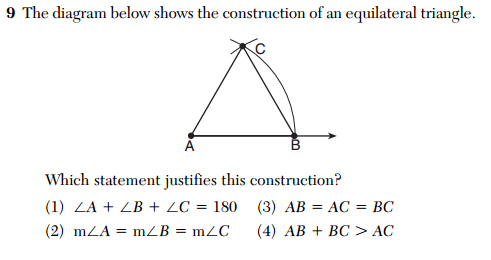
I’ve chronicled some of the larger issues I saw this January here, but there were a few irritating problems that didn’t quite fit elsewhere.  Like number 9 from the Geometry exam.

Regents 2013 January G 9

First of all, I don’t really understand why we bother writing multiple choice questions about constructions instead of just having students perform constructions.  Setting that issue aside, this question is totally pointless.

The triangle is equilateral.  Regardless of how it was constructed, the fact that AB = AC = BC will always justify its equilateralness.  Under no circumstance could the fact that  AB = AC = BC not justify a triangle is equilateral.  The construction aspect of this problem is entirely irrelevant.

Next, I really emphasize precise use of language in math class.  In my opinion, in order to think clearly about mathematical ideas, you need to communicate clearly and unambiguously about them.  The wording of number 32 from the Algebra 2 / Trig exam bothers me.

Regents 2013 January AT 32

What does the answer mean in the phrase “express the answer in simplest radical form”?  Presumably it means “the two solutions to the equation”, but “answer” is singular.  And if it means “the set of solutions”, well, you can’t put a set in simplest radical form.

Are we trying to trick the students into thinking there’s only one solution?  Or is this just a lazy use of the word “answer”, like the way students lazily use the word “solve” to mean dozens of different things?  I understand that this is nit-picking, but this is a particular pet peeve on mine.

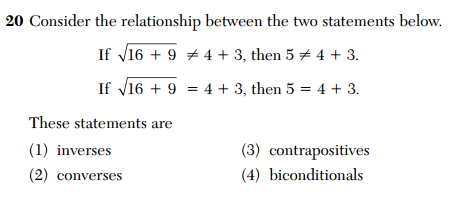
Lastly, number 20 from the Geometry exam is simply absurd.  Just looking at it makes me uncomfortable.

Regents 2013 January G 20I’m sure we can find a better way to test knowledge of logical relationships than by promoting common mathematical errors!

Regents Recap — January 2013: Recycled Problems

Here is another installment in my series reviewing the NY State Regents exams in mathematics.

I reuse problems on tests all the time.  I’m sure every teacher does.  Sometimes I’ll change a number or two, sometimes I’ll change what the question asks for, or sometimes I’ll use the problem just as it is.

But I’m not writing tests for thousands of students state-wide, and my tests don’t determine whether or not students graduate, teachers keep their jobs, or schools remain open.

So it seems reasonable to ask if reusing problems on high-stakes exams, like the Regents, is an appropriate practice.

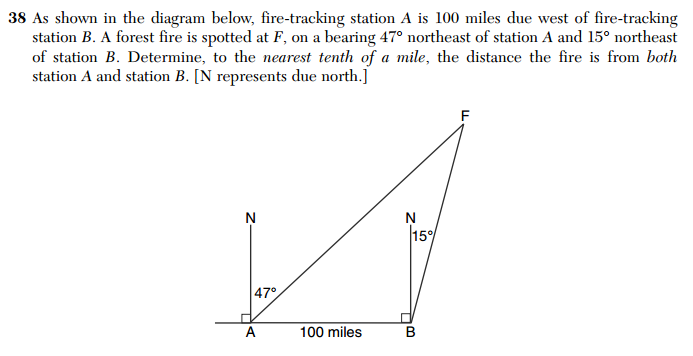
Compare number 38 from the January 2013 Algebra 2 / Trig exam

Regents 2013 January AT 38

with number 27 from the 2005 Math B exam.

Regents 2013 January Math B 27And one more important difference between my tests and these standardized tests:  I don’t pay millions of dollars to educational specialists to develop my exams.

Related Posts


Math Quiz — NYT Learning Network

cooper unionThrough Math for America, I am part of an ongoing collaboration with the New York Times Learning Network.  My latest contribution, a Test Yourself quiz-question, can be found here:

Test Yourself Math — March 6, 2013

This question is about how the Cooper Union is contemplating an end top its longstanding no-tuition policy, due in part to a current $12 million operating loss.  How much would Cooper Union have to charge in tuition to cover that loss?

Follow

Get every new post delivered to your Inbox

Join other followers: