 A common debate in math education centers on the extent to which students should memorize things, like multiplication tables, the quadratic formula, or the division algorithm.
There are many sensible arguments against memorizing algorithms. While memorizing algorithms might produce good results in a typical math class, mathematics makes the most sense when it is understood as a coherent, interconnected system of thought. We want students to be resourceful and creative problem solvers, and this requires that students understand the context and the connections, not merely the steps, of the procedures they learn.
Occasionally this argument is taken to the extreme and teachers altogether discourage memorization of algorithms and procedures, claiming that it’s pointless for students to have the procedural knowledge without understanding the context.
While there is some merit to this argument, I was recently reminded how valuable it can be to blindly memorize algorithms.
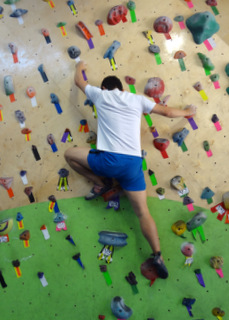
A friend invited me to go rock-climbing, something I had never done before. We arrived at the gym, and my friend, an experienced climber, showed me how to identify the beginner trails on the wall and encouraged me to get climbing right way. Over the next hour I attempted a few trails, and met with more frustration than success.
After a particularly discouraging attempt, I sat down next to my friend to rest. He told me that he noticed I was getting stuck in the middle of the trail and was having difficulty finding the next hold. He suggested that I examine the trail before I start the climb and memorize the sequence of moves needed to make it to the top.
By memorizing the wall-climbing algorithm, I was freed from trying to do too many things at once. I could focus on developing the fundamental techniques — proper holds, balance, body position, different reaches — without worrying about what the next step should be.
Ultimately we want the ability to be on an unfamiliar wall, or in an unfamiliar problem, and have the confidence and skill to figure out what to do next. But this skill is really a combination of many skills, and it can be challenging, and frustrating, to try to develop them them all simultaneously.
Sometimes memorizing things — like a sequence of handholds, or the quadratic formula — can help us get to the top. And it can help prepare us for the day when memorizing won’t be enough.
 I am very proud of my students, Ahmed and Jason, who presented their peer-to-peer math enrichment program MathMatters! at this year’s TEDxNYED conference.