Regents Recap — June 2013: Solving Quadratic Equations

Here is another installment in my series reviewing the NY State Regents exams in mathematics.

Solving equations is a fundamental mathematical skill, and it makes sense that we emphasize it in school curricula.  And since quadratic functions come up quite a bit in mathematical and scientific exploration, and offer a good balance of accessibility and complexity, it makes sense that solving quadratic equations is a particular point of emphasis.

This June, each of the three New York math Regents exams had at least one problem that required the student to solve a quadratic equation.  I don’t really have any objection to this, but what I find strange is the implied gap in mathematical content suggested by the types of questions asked.

Consider the following two questions.  The first is from the Integrated Algebra exam and the second is from the Algebra 2 / Trig exam.  These two exams, and their corresponding courses, are typically taken 2-3 years apart.
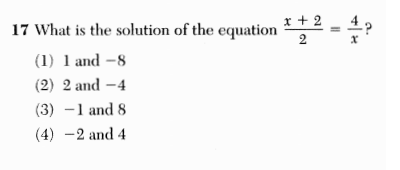
2013 June IA 17

2013 June A2T 36

The only difference between the content of these questions is the nature of the solutions of the equations.  In the first, the solutions are integers; in the second, the solutions are irrational numbers.  Thus, students are taught to solve quadratic equations with integer solutions in the Integrated Algebra course, but it isn’t until at least two years later that they are taught to solve quadratic equations with non-integer solutions.

That seems like an unreasonably long gap to me.  I’m not sure what the reasoning is behind waiting 2-3 years to teach students how to solve more complicated quadratic equations.  Maybe someone can make a sensible argument for this pacing and structure, but I’m not sure I can.
Regents Recap — June 2013: Where Do Systems Belong?

Here is another installment in my series reviewing the NY State Regents exams in mathematics.

Consider the following three questions from the June 2013 New York math Regents exams.

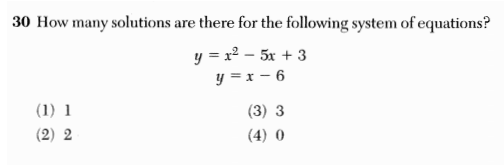
2013 June IA 30

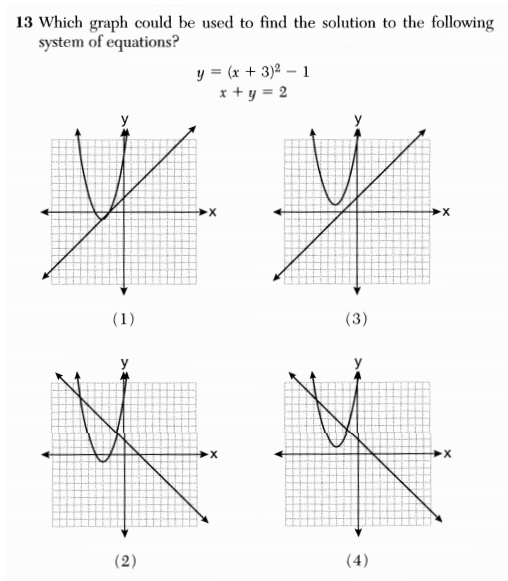
2013 June G 13

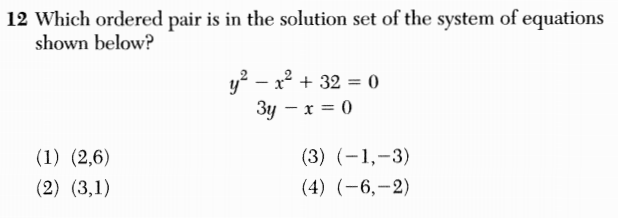
2013 June A2T 12

From top to bottom, these questions appeared on the Integrated Algebra exam, the Geometry exam, and the Algebra 2 / Trig exam.

Solving systems of equations is a fundamental mathematical skill and should be a part of any math course.  But do these three questions really span 3-4 years of mathematical learning?

The first two are simply different representations of the same problem.  The third question involves a relation instead of a function, but it’s presentation as a multiple choice question sidesteps any additional algebraic or geometric complexity that dealing with a relation might entail.  Ironically I think the question from the earliest exam is the hardest of the three.

I’ve written about this curious treatment of systems of equations in analyzing other Regents exams.  This phenomenon comes to mind when politicians and administrators take credit for raising test scores, or trumpet gains in student growth from year-to-year.

Math Quiz — NYT Learning Network

oregon -- us mapThrough Math for America, I am part of an ongoing collaboration with the New York Times Learning Network. My latest contribution, a Test Yourself quiz-question, can be found here

Test Yourself Math — July 15, 2013

This question is about Oregon’s proposed college financing plan that would allow students to attend college tuition-free in exchange for a small percentage of their future yearly earnings.  How much might an average graduate pay under this proposal?

Math Photo: Parallel Lines Make Congruent Segments

Parallel Lines Congruent Segments

Here’s a demonstration of a theorem of elementary geometry:  if parallel lines divide one transversal into congruent parts, then they divide all transversals into congruent parts.

Here, it’s easy to see that the top rail, the one perpendicular to the parallel posts, is divided into equal parts by the vertical posts.  So the angled segments are divided into congruent parts as well.

Regents Recap — June 2013: Erroneous Questions, Part 2

As part of my ongoing series reviewing the NY State Regents exams in mathematics, I recently wrote about mathematically erroneous questions in the June 2013 exams.

In the original post I took issue with number 25 from the Algebra 2 / Trig Regents exam.

2013 June A2T 25I complained that the denominator here can’t really be “rationalized” since it is a variable expression.  This complaint was thoughtfully refuted by a commenter who pointed out that I was thinking of the process of “rationalizing” as applying only to numbers.  The process can be interpreted to apply to functions, and while I personally don’t like this use of the term, it does appear as a standard in the Alg 2 / Trig course.  As a result, I withdrew my criticism and updated the post.

Ironically, the commenter’s thoughtful and informed refutation actually pointed to a different reason this question is mathematically erroneous.  [This emphasis here is mine.]

Admittedly, they never specify whether this expression is meant to represent a function of x or a specific number. They certainly intended the former, since they say the answer is (1) rather than (4): technically, (1) and (4) define slightly different functions (since 0 is in the domain of (4) but not (1)),while if you interpreted the original problem as a number, then (1) and (4) would define exactly the same number as you started with.

If we are talking about functions, then although (1) and (4) both appear to be equivalent to \frac{x}{x-\sqrt{x}}, only (1) is truly equivalent since only (1) has the same domain (x \ne 1, x \ne 0) as the original.  The commenter argues that declaring (1) and not (4) to be the correct answer is evidence that the test-makers intended the question to be about rationalizing functions, and that they understand the mathematics of the situation.

This is an excellent point.  As it turns out, however, I had mistakenly reported that (1) was the official correct answer.  In fact, (4) is the official correct answer, despite the fact that it is not equivalent to the original expression (which, unlike (4), is undefined for x = 0).  Incidentally, this lack of understanding of equivalent expressions is consistently demonstrated on these exams.

Presumably, the requirement that the answer be in simplest form is what makes (4) and not (1) correct in the minds of the test-makers.  But cancelling out common variable factors doesn’t just simplify expressions–it changes them by altering their apparent domains.   And to me, simplest form is a characteristic of numbers only, not of expressions, which further clouds the issue of what the authors intended here.

A follow-up question might help clarify the mathematical thinking here:  how would one express \frac{x}{x-\sqrt{2}} with a rational denominator and in simplest form?

Follow

Get every new post delivered to your Inbox

Join other followers: