Unscrambling the Hidden Secrets of Superpermutations — Quanta Magazine

My latest column for Quanta Magazine brings the exciting story of superpermutations down to the level of high school counting.

A superpermutation is a string of symbols in which each permutation, or arrangement, of those symbols appears in some order. Imagine, for example, you are trying to thwart the evil plans of a mad scientist and must key in a secret passcode:

Suddenly, inspiration strikes. If you punch in 123451, you’re actually trying two codes: 12345 and 23451. Even better, entering 1234512 will succeed if the code is 12345, 23451 or 34512.

You do some quick calculations. Instead of keying in 600 digits to cover all the possibilities, you now only have to enter 153 digits. You have just enough time — and it works! You’ve saved the day. It’s a good thing you read about “superpermutations” in Quanta.

Finding minimal length superpermutations is a open research problem in mathematics, but recent developments have come from the most unlikely of places! Find our more by reading the article, which is freely available here.
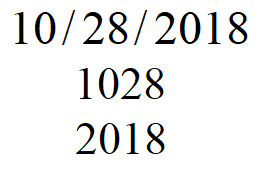
10/28/2018 — Happy Permutation Day!

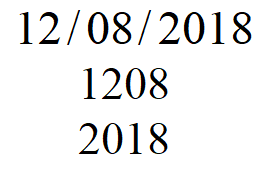
Today we celebrate a Permutation Day! I call days like today permutation days because the digits of the day and the month can be rearranged to form the year.

We can also consider today a Transposition Day, as we need only a single transposition (an exchange of two numbers) to turn the year into the day and date.

Celebrate Permutation Day by mixing things up! Try doing things in a different order today. Just remember, for some operations, order definitely matters!

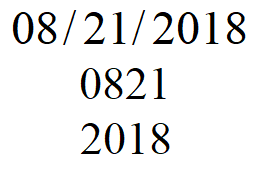
08/21/2018 — Happy Derangement Day!

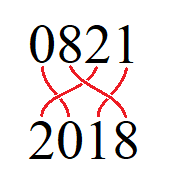
Today we celebrate a Derangement Day! Usually I call a day like today a Permutation Day because the digits of the day and month can be rearranged to form the year, but there’s something extra special about today’s date:

The numbers of the month and day are a derangement of the year: that is, they are a permutation of the digits of the year in which no digit remains in its original place!Derangements pop up in some interesting places, and are connected to many rich mathematical ideas. The question “How many derangements of n objects are there?” is a fun and classic application of the principle of inclusion-exclusion. Derangements also figure in to some calculations of e and rook polynomials.

So enjoy Derangement Day! Today, it’s ok to be totally out of order.

Follow

Get every new post delivered to your Inbox

Join other followers: