Regents Recap — June 2015: Trouble with 3D Geometry

Here is another installment in my series reviewing the NY State Regents exams in mathematics.

The Common Core standards have brought a slight increase in three dimensional reasoning into high school Geometry.  I think this is generally a good thing:  3D geometry is typically given short shrift in this course, but is a beautiful and intriguing topic.

It can also be a confusing topic, as these problems from the inaugural Common Core Geometry Regents exam demonstrate.
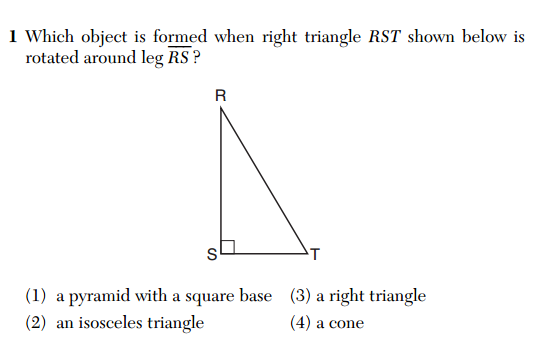
2015 CC GEO 1

According to the scoring guide, the correct answer is (4) a cone.  Technically, however, the correct answer is (3) a right triangle.

Rotation is a rigid motion:  it does not change a figure’s size or shape.  If a right triangle is rotated about an axis, it will remain a right triangle.  Presumably, the intent of this question is for the student to identify the solid of revolution formed by revolving the triangle about an axis.  But that is a different question than the one posed.  Ironically, the notion that rigid motions preserve size and shape is one of the fundamental principles in the transformation-based approach to geometry embodied by the Common Core standards.

Here’s another problematic 3D geometry question.2015 CC GEO 6
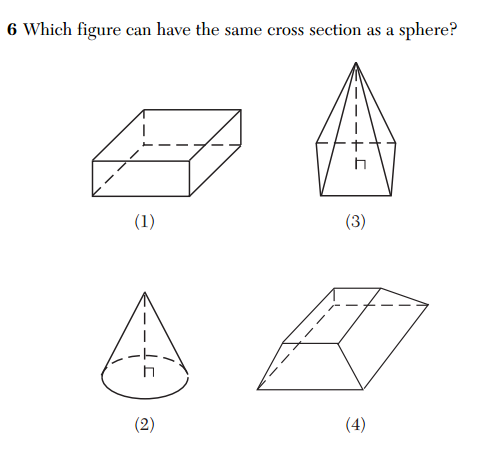
According to the answer key, the correct answer is (2).  But the actual correct answer is all of these.  While most cross-sections of spheres are circles, some cross-sections of spheres are single points (when the cross-sectional plane is tangent to the sphere).  All the given objects have single point cross-sections as well, thus, could all have the same cross section as a sphere.

This is certainly not the first time we’ve seen problematic three dimensional geometry questions on these Regents exams (here’s a particularly embarrassing example), and I’ve been chronicling mathematically erroneous questions on these tests for years.  Errors like this are often dismissed as insignificant, or “typos”, but because of the high-stakes nature of these exams, these errors have real consequences for students and teachers.

If these exams don’t model exemplary mathematics and mathematical practice, their credibility in evaluating the mathematical practice of students and teachers must be questioned.
Cavalieri’s Principle and 3D Printing

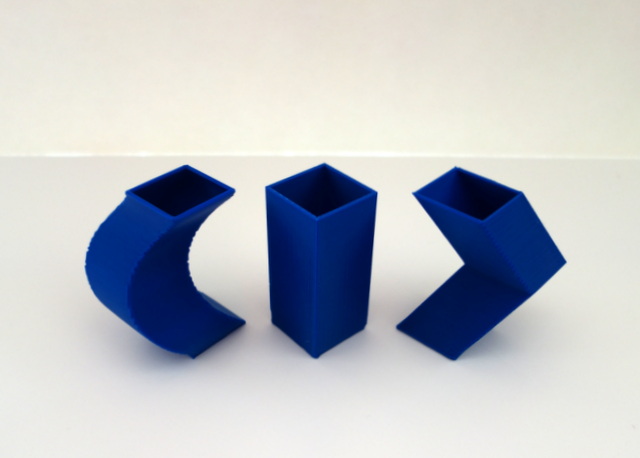
These 3D printed objects served as an excellent starting point for a classroom conversation on Cavalieri’s Principle.

3DP and Cavalieri

Each shape above is an extrusion of the same square.  In the middle, the square moves straight up; at left, the square travels in a complete circle from bottom to top; and at right, the square moves along a line segment and back.

The objects all have the same height.  Since at every level they have the same cross-sectional area, by Cavalieri’s Principle they all have the same volume!

Cavalieri’s Principle is a simple but powerful idea, and one that can be easily demonstrated around the house.  Here are some other examples using CDs and CD cases.


Sum of Angles in Star Polygons

Futility Closet recently posted a nice puzzle about the sum of the angles in the “points” of a star polygon.

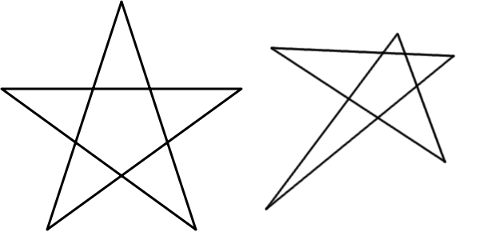
http://commons.wikimedia.org/wiki/File:Pentagram.svg

It’s easy to show that the five acute angles in the points of a regular star, like the one at left, total 180°.

Can you show that the sum of these angles in an irregular star, like the one at right, is also 180°?  (link)

A clever proof is shown, but what I would consider the standard proof is clever, simple, and beautifully generalizable.

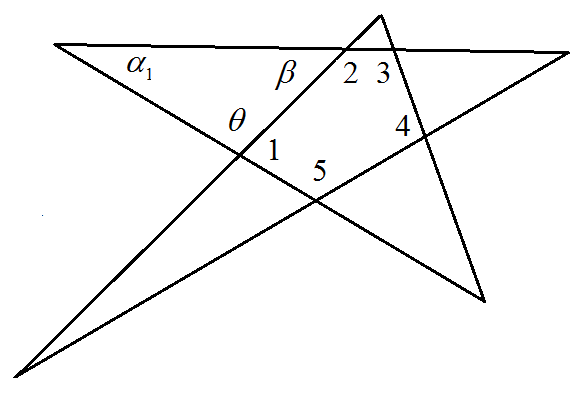
Consider the star pentagon below.

star polygonBy the exterior angle theorem, we have

\angle 1 = \alpha_1 + \beta

\angle 2 = \alpha_1 + \theta

 So

\angle 1 + \angle 2 = \alpha_1 + \alpha_1 + \beta + \theta = \alpha_1 + 180 \textdegree

where the last equality follows from the triangle angle sum formula.

Do this for each of the five “points” and sum the equations

2( \angle 1 + \angle 2 + \angle 3 + \angle 4 + \angle 5) = \sum \alpha_i + 5 \times 180 \textdegree

Now, the sum of the interior angles of any pentagon, regular or not, is 540 \textdegree, so this becomes

2 \times 540 \textdegree = \sum \alpha_i + 5 \times 180 \textdegree

And so, a little arithmetic gives us

\sum \alpha_i = 180 \textdegree

For stars of this type, where the points are formed by intersecting two sides of an n-gon that are separated by exactly one side, this method generalizes beautifully.  The above equation becomes

2 \times (n-2) \times 180 \textdegree = \sum \alpha_i + n \times 180 \textdegree

which simplifies to

\sum \alpha_i = (n-4) \times 180 \textdegree

In particular, we see that when = 5, we have that \sum \alpha_i = 180 \textdegree.  And one of the best things about having a formula like this is asking questions like “What happens when n = 4?” and “What happens when = 3?”!

Now, there are other types of star polygons.  For example, if you start with an octagon, extend the sides, and consider the intersections of two sides that themselves are separated by exactly two sides of the octagon, you get something that looks like this.

8-3 star polygon

While the formula above doesn’t apply to this star, a similar technique does.  The big difference is that, instead of the star’s points being attached an an n-gon (a pentagon, in the first example), this star’s points are attached to another star polygon!  There are lots of fun directions to go with this exploration.

Follow

Get every new post delivered to your Inbox

Join other followers: