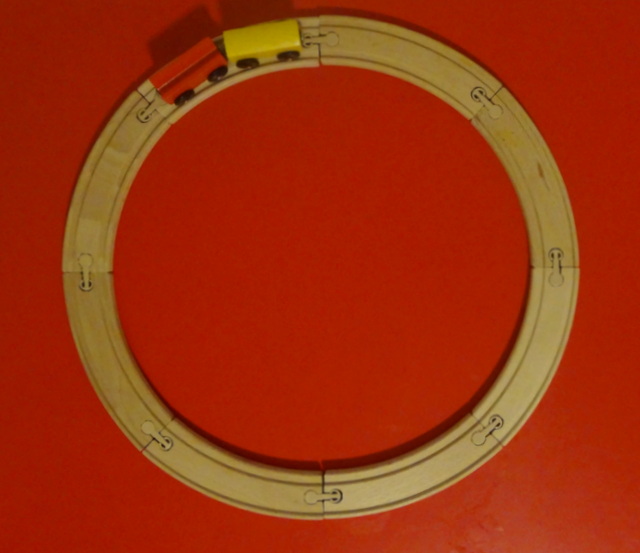
04/21/2014 — Happy Derangement Day!

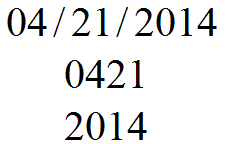
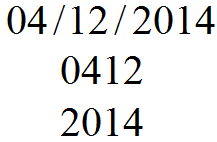
Today we celebrate a Derangement Day!  Usually I call a day like today a permutation day because the digits of the day and month can be rearranged to form the year, but there’s something extra special about today’s date:
04212014

The numbers of the month and day are a derangement of the year:  that is, they are a permutation of the digits of the year in which no digit remains in its original place!

Derangements pop up in some interesting places, and are connected to many rich mathematical ideas.   The question “How many derangements of n objects are there?” is a fun and classic application of the principle of inclusion-exclusion.  Derangements also figure in to some calculations of e and rook polynomials.

So enjoy Derangement Day!  Today, it’s ok to be totally out of order.
Pi Day 2014

I don’t usually celebrate Pi Day, but a variety of inspirations intersected at a fun project idea this time around.

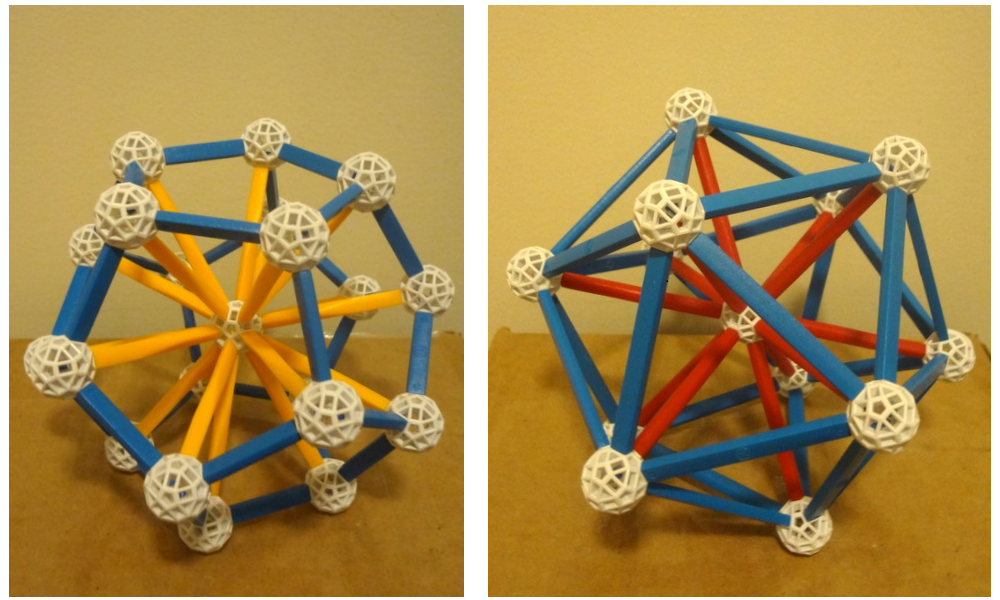
Thanks to Math for America, I participated in a terrific workshop on Zometool earlier this year, led by George Hart.  We built, explored, conjectured, proved, and collaborated around a lot of rich mathematical ideas.  And this semester, Steven Strogatz is teaching a History of Math course at Cornell, and he has been generously sharing thoughts and resources online.  As a result, I have been reading up on the derivations of the volume and surface area formulas for Platonic and Archimedean solids.

So when I recently re-watched James Tanton’s brilliant video “What is Pi for a Square?“, the idea hit me:  for Pi Day, students could explore the value of “Pi” for various Zometool-constructible solids!

pi day combo

What makes James Tanton’s exploration so wonderful is that it highlights the invariance of Pi in circles (as circumference by diameter) while inviting students to play around with the notions of “diameter” “radius”, and “Pi” in regular polygons.  We’ll be taking the question “What is Pi?” up a dimension, and thanks to Zometool, we have a tangible context for our conversations and calculations.

We’ll be exploring properties of polyhedra, calculating areas, volumes and ratios, arguing about definitions, and comparing the sphereness of various things.  I’m looking forward to a great day of mathematics!  And perhaps discovering what the value of “Pi” is for a rhombic triacontahedron.

Follow

Get every new post delivered to your Inbox

Join other followers: