Well, it took a while, but my Penrose Magnets have finally arrived! We are going to have a lot of fun with these.

Well, it took a while, but my Penrose Magnets have finally arrived! We are going to have a lot of fun with these.
Here is another installment in my series reviewing the NY State Regents exams in mathematics.
I reuse problems on tests all the time. I’m sure every teacher does. Sometimes I’ll change a number or two, sometimes I’ll change what the question asks for, or sometimes I’ll use the problem just as it is.
But I’m not writing tests for thousands of students state-wide, and my tests don’t determine whether or not students graduate, teachers keep their jobs, or schools remain open.
So it seems reasonable to ask if reusing problems on high-stakes exams, like the Regents, is an appropriate practice.
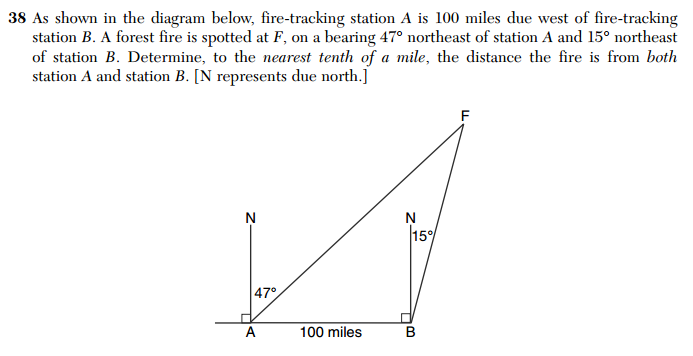
Compare number 38 from the January 2013 Algebra 2 / Trig exam
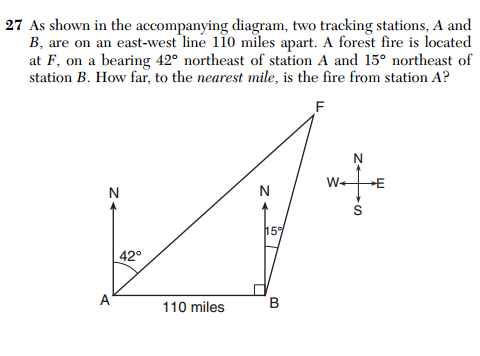
with number 27 from the 2005 Math B exam.
 And one more important difference between my tests and these standardized tests: I don’t pay millions of dollars to educational specialists to develop my exams.
Related Posts
 Through Math for America, I am part of an ongoing collaboration with the New York Times Learning Network. My latest contribution, a Test Yourself quiz-question, can be found here:
Test Yourself Math — March 6, 2013
This question is about how the Cooper Union is contemplating an end top its longstanding no-tuition policy, due in part to a current $12 million operating loss. How much would Cooper Union have to charge in tuition to cover that loss?
Here is another installment in my series reviewing the NY State Regents exams in mathematics.
One consequence of scrutinizing standardized tests is a heightened sense of the role question design plays in constructing assessments.
Consider number 14 from the Integrated Algebra exam.
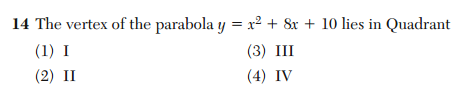
In order to correctly answer this question, the student has to do two things: they need to locate the vertex of a parabola; and they need to correctly name a quadrant.
Suppose a student gets this question wrong. Is it because they couldn’t find the vertex of a parabola, or because they couldn’t correctly name the quadrant? We don’t know.
Similarly, consider number 21 from the Geometry exam.
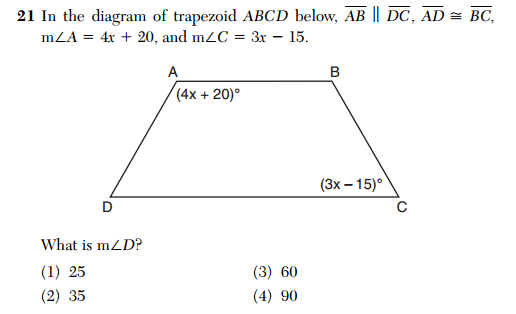
This is a textbook geometry problem, and there’s nothing inherently wrong with it. But if a student gets it wrong, we don’t know if they got it wrong because they didn’t understand the geometry of the situation, or because they couldn’t execute the necessary algebra.
Using student data to inform instruction is a big deal nowadays, and collecting student data is one of the justifications for the increasing emphasis on standardized exams. But is the data we’re collecting meaningful?
If a student gets the wrong answer, all we know is that they got the wrong answer. We don’t know why; we don’t know what misconceptions need to be corrected. In order to find out, we need to look at student work and intervene based on what we see.
And what if a student gets the right answer? Well, there is a non-zero chance they got it by guessing. In fact, on average, one out of four students who has no idea what the answer is will correctly guess the right answer. So a right answer doesn’t reliably mean that the student knows how to solve this problem, anyway.
So what then, exactly, is the purpose of these multiple choice questions?
