
Teaching
Are The New Tests More Rigorous?
The release of student test data from 2013 has educators, administrators, politicians, and parents abuzz in New York. These are the first state exams aligned to the Common Core standards, and as widely predicted, proficiency rates have plummeted, leaving everyone scrambling to explain what has happened.
The most common explanation offered is that these new tests are substantially more rigorous than the old ones, so lower student performance is to be expected. I was curious about the claim that the new tests are more rigorous, and while the state does not release the exams to the public, they do publish a small number of questions from each grade level.
The new tests were administered in grades 3-8. As a high school teacher, I am not well-versed in elementary school tests, but I have spent a substantial amount of time scrutinizing New York state math Regents exams, so I thought I’d look at the 8th grade math questions that were released to the public. I was quite surprised by what I saw.
The “representative sample” of 8th grade math questions does not seem more rigorous to me. They do not seem to emphasize “deep analysis” or “creative problem solving over short answers and memorization”, which is often how the new standards are characterized. I can’t say I was surprised to discover this.
What did surprise me, however, was how many of these 8th grade math questions were virtually identical to questions that have recently appeared on high school math Regents exams.
Here is the first example from the set of 8th grade math questions released to the public:
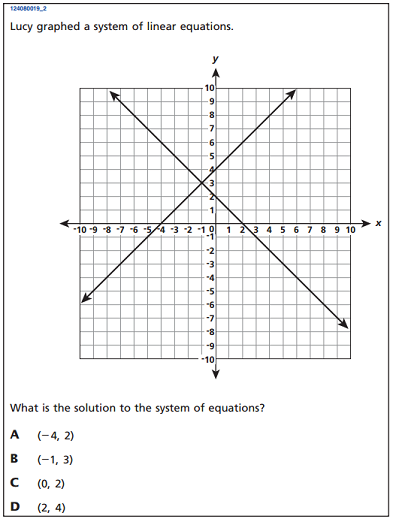
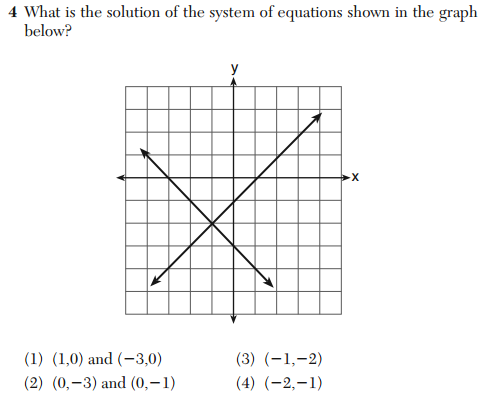
This problem is essentially the same as #4 from the January, 2013 Integrated Algebra exam
The second example from the set of 8th grade math questions released to the public
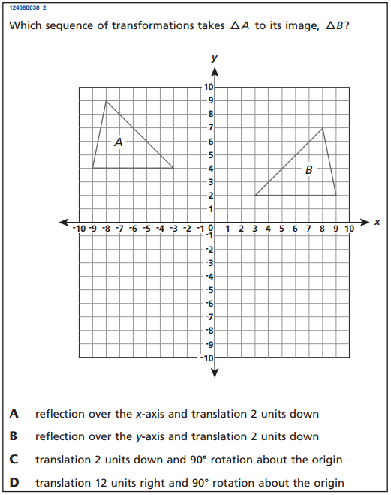
is quite similar to #4 from the January, 2013 Geometry exam
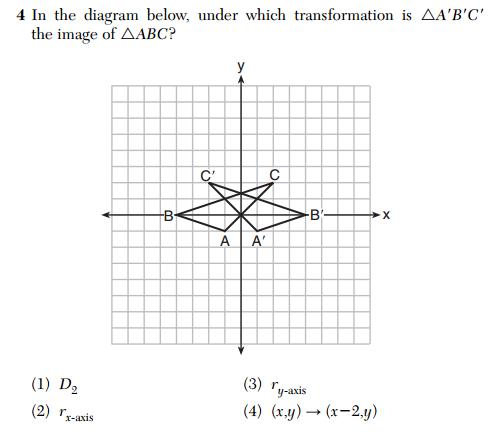
And the fourth example from the set of 8th grade math questions released to the public
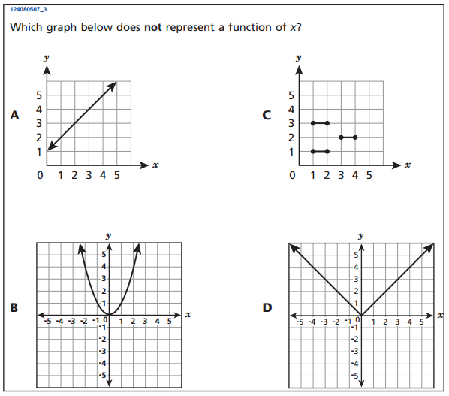
is essentially the same as #9 from the January, 2013 Integrated Algebra exam
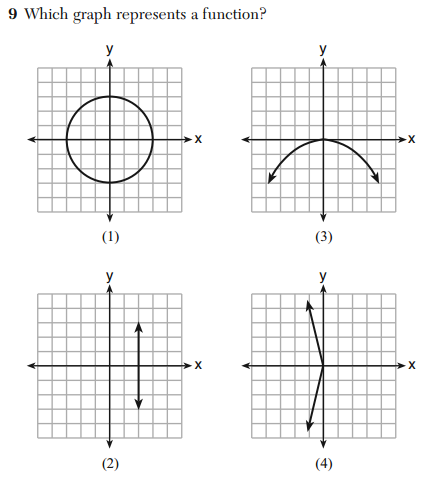
This surprising discovery left me with a lot of questions.
First, why are 8th graders facing the same kinds of questions on this state exam that 9th, 10th, 11th, and even 12th graders faced this year? Were teachers and students prepared to see this kind of content on the 8th grade exam?
Second, how can it be argued that this new test is more rigorous if it is comprised of the same kinds of questions that appear on the old tests? Simply moving a question from a 10th-grade test to an 8th-grade test doesn’t transform the question into one that requires deep analysis or creative problem solving. More rigorous questions would ask students to construct mathematical objects, explore concepts from different perspectives, and demonstrate mathematical reasoning. None of the above questions do this: they are not especially challenging, deep, or novel. In short, they are typical standardized test fare.
And perhaps the most important question is this: if these are the hand-picked exemplar questions released to the public, what must the rest of the test look like? Only by releasing the entire test to the public can we truly assess what we are assessing.
A version of this post appears at GothamSchools.
Challenge NYT
Math Quiz — NYT Learning Network
 Through Math for America, I am part of an ongoing collaboration with the New York Times Learning Network. My latest contribution, a Test Yourself quiz-question, can be found here
Test Yourself Math — August 5, 2013
This question deals with the amount of money election campaigns spend on advertising. Approximately how much was spent per voter at one Ohio TV station in 2012?
Photography
Math Photo: Coordinatization

In order to better understand a space we often impose a coordinate system on it. This allows us to study the characteristics of that space in particularly mathematical ways, like through distance, area, and curvature.
Looking at the city through this rectangular mesh put me in mind of this process of coordinatization, and highlights how the coordinate system is indeed an abstraction from reality and an active choice we make.
Challenge NYT
Math Quiz — NYT Learning Network
 Through Math for America, I am part of an ongoing collaboration with the New York Times Learning Network. My latest contribution, a Test Yourself quiz-question, can be found here
Test Yourself Math — July 31, 2013
Eike Batista, a Brazilian businessman, has seen his personal fortune drop from $34.5 billion to $4.8 billion in the past year. Approximately how many average Brazilian households is his current fortune equivalent to?