Barron’s SHSAT Prep Book

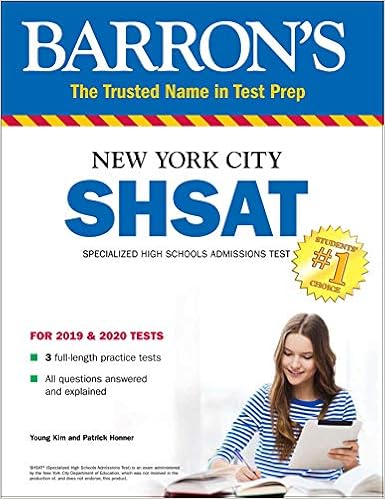
I’m excited to announce that the SHSAT Prep Book I co-authored for Barron’s has been published!

This book is designed to prepare middle school students for New York City’s Specialized High School Test (SHSAT). The SHSAT is the sole admissions criterion for entry into New York City’s specialized schools, which include Stuyvesant, Bronx Science, and Brooklyn Tech. The test is free, and every middle school student in the city is eligible to take it.

This new book reflects the recent changes to the content of the SHSAT, which was re-designed to better represent the standard 7th and 8th grade curricula. It includes an overview of all of the math and ELA content covered on the exam, as well as three complete practice tests.

The book was written with co-author Young Kim, and is currently available on Amazon and in Barnes and Noble stores in New York City.

Color Me Polynomial — Quanta Magazine

My latest column for Quanta Magazine highlights one of math’s most misunderstood objects: the polynomial. Polynomials may be the bane of an algebra student’s existence, but polynomials help us see the mathematical structure around us.

At some point in school you were probably asked to combine, factor and simplify polynomials. For example, you may remember that x² + 2xy + y² = (x + y)². That’s a neat algebra trick, but what is it actually good for? It turns out that polynomials excel at uncovering hidden structure, a fact Huh used to great effect in his proof. Here’s a simple puzzle that illustrates how.

My column explores how certain polynomials, called chormatic polynomials, can tell us about the structure of certain graphs, and vice versa. This intimate connection lies at the heart of some interesting results in graph theory, including some big theorems that were proved only recently.

To learn more, read the full article, which is freely available here.
NSTA STEM Forum

Next week I’ll be in San Francisco for the 2019 STEM Forum and Expo, hosted by the National Science Teachers Association. This annual conference brings together thousands of educators from around the world to talk about STEM education, share resources, and discuss outreach strategies.

As part of my work as an NCTM / NSTA National STEM Teacher Ambassador, I’ll be participating in an opening panel on STEM teaching on Thursday, and a Share-a-Thon of classroom resources on Friday. I’ll also be presenting “STEM Up Math Class with Computing”, which relates to my work integrating computer science into math class.

You can learn more about the STEM Forum here, and see the full program of events here.

Related Posts

How Geometry, Data and Neighbors Predict Your Favorite Movies — Quanta Magazine

My latest column for Quanta Magazine makes a connection between high school geometry and recommendation engines used by companies like Netflix.

Adrienne is a Marvel movie fanatic: Her favorite films all involve the Hulk, Thor or Black Panther. Brandon prefers animated features like Inside Out, The Incredibles and anything with Buzz Lightyear. I like both kinds, although I’m probably closer to Adrienne than Brandon. And I might skew a little toward Cora, who loves thrillers like Get Out and The Shining.

Whose movie preferences are closest to yours: Adrienne’s, Brandon’s or Cora’s? And how far are your cinematic tastes from those of the other two? It might seem strange to ask “how far” here. That’s a question about distance, after all. What does distance mean when it comes to which movies you like? How would we measure it?

Using the perpendicular bisector–an elementary and underappreciated idea from high school geometry–we can carve up abstract data spaces into regions that can be fruitfully compared and contrasted. And knowing which region you lie in, and whom you are closest to, can help make predictions about your preferences.

To learn more, read the full article, which is freely available here.
Follow

Get every new post delivered to your Inbox

Join other followers: