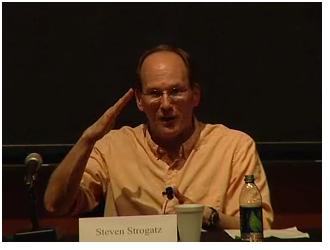
 This video lecture from the Princeton Public lecture series features psychologist Stanislas Dehaene and mathematician and author Steven Strogatz discussing math, learning, and teaching.
Dehaene, a leading researcher in how the brain acquires and processes mathematical knowledge, has some interesting things to say about whether mathematics is innate or learned. He also describes some fascinating research conducted on number sense and geometric understanding in primitive societies.
What I enjoyed most in this lecture, however, are the two stories from Steven Strogatz about his personal experiences learning math. At around the 23:30 mark, Strogatz tells the story of when he first became “really interested” in math. Strogatz is a wonderful storyteller, and the tale should resonate with anyone who has discovered, or is discovering, their passion for math or science.
Strogatz’s second story is about his first experience being “weeded out” in an advanced math course in college. This is a story I wish I had heard as a student, and it’s something I’ll definitely be sharing with my students from now on.
And for more on math and teaching from Professor Strogatz, check out how his book “The Calculus of Friendship” is a great read for advanced math students.