Hands on a Subway Pole

When I describe the role mathematics plays in my life, I often say that it gives me a set of tools to process and understand the world.  One way that manifests itself is that I see graphs everywhere.

For example, when I look at a pole on the subway, I see the distribution of hands that have been on the pole.
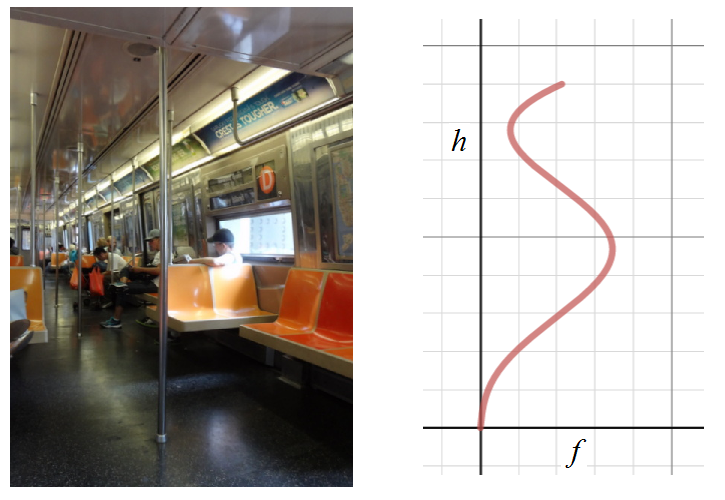
hands on a subway combo

I think about things like this because they are interesting, but also because they are practical.  Where is the pole the dirtiest, and cleanest?  Where are germs most likely to reside?  New Yorkers know instinctively to touch as little as possible, but sometimes you have no choice.  Best to know your probabilities ahead of time.

Cogito, Ergo, Summer

cogito ergo summerI was quite surprised to find myself prominently featured in the New Yorker essay, “Cogito Ergo Summer“, by Siobhan Roberts.

The piece begins ominously:

Patrick Honner, a math teacher at Brooklyn Technical High School, arrived at a recent class seemingly unprepared. This was surprising, given that, days before, he had received a Presidential Award for Excellence in Mathematics and Science Teaching. 

“Cogito, Ergo, Summer” is about the important role recreation plays in studying mathematics and science.  Summer is a time to relax and have fun, far from the responsibilities of the classroom and lab.  But for mathematicians and scientists, it is also a time for serious play.

Roberts experienced this firsthand this summer at both the Bridges Math and Art conference and the MOVES conference at the Museum of Mathematics, where she spoke about her new book “Genius at Play: The Curious Mind of John Horton Conway“.  Few know the value of mathematical play as well as Conway, which Roberts clearly captured in her work.

As summer comes to an end, it’s nice to reflect on a busy summer of serious play.  And here’s hoping those experiences can fuel us through another busy academic year!

Is Steven Strogatz Writing Regents Exam Questions?

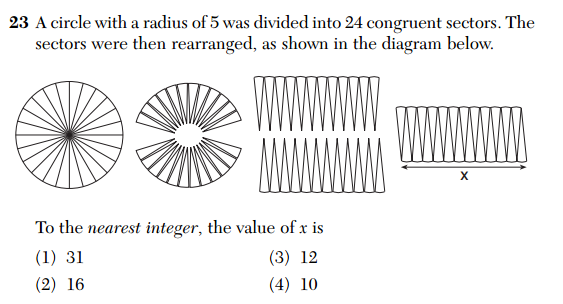
When I saw this question on the 2015 Common Core Geometry Regents exam, I couldn’t help but think of mathematician and author Steven Strogatz.

2015 CC GEO 23

Strogatz wrote a popular series on math in the New York Times, and in his piece “Take it to the Limit“, he shares a beautiful and intuitive derivation of the formula for the area of a circle.  That technique involves slicing the circle up into sectors and re-arranging them into a shape that approximates a rectangle.

Circle with many slices

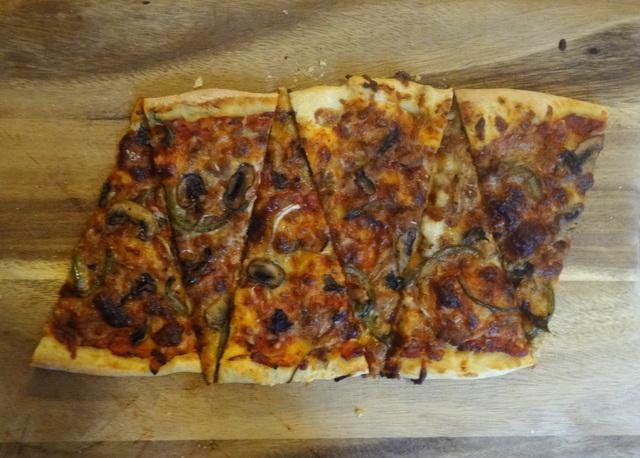
I’m certain his piece inspired this question (which I like), just as it inspired me when I was cutting up my homemade pizza!

Pizza Rectangle

Maybe we can add test prep to the long list of reasons to be reading Steve’s work!

Follow

Get every new post delivered to your Inbox

Join other followers: